

Some Folks are Just Dying to Be Neighbors With Dead Famous People
Location is the number one rule in real estate — and that includes the plot of land (or niche of concrete) in which someone wants to spend eternity. Some people want a resting place high atop a hill overlooking their beloved hometown. Others, like actress Christina Applegate, want a shady spot under a tree so mourners can visit without breaking a sweat.
The priority of most plot purchasers, however, is their potential neighbors. While many want to be buried next to a family member or other loved ones, some folks want nothing less than lying vault-to-vault with someone who achieved fame during their lifetime. For at least the last two centuries, people have been paying a premium to rest next to the rich, famous, and even infamous, and it’s a trend that’s still going strong, if not growing.
Not zip codes, but sections
According to a recent New York Post piece, one Marilyn Monroe superfan paid $195,000 at auction for a one-space mausoleum crypt near her resting place at Pierce Brothers Westwood Village Memorial Park in Los Angeles, calling it a “once-in-a-lifetime chance to spend eternity” beside cinema’s most iconic blonde. In the same cemetery, a Judy Garland admirer spent more than $50,000 on a glass-front niche just steps from Dorothy herself. A Pierce Brothers staff member is quoted as saying that roughly “70% of their plots have been sold in advance because of proximity to certain celebrities.”
This pattern isn’t limited to the Hollywood area, either. Woodlawn Cemetery in the Bronx was receiving so many requests to be buried near jazz royalty Miles Davis and Duke Ellington that they designated the section where they and others reside as “Jazz Corner” and are building 2,275 new burial plots adjacent to it.
The trend has even hit Europe. In 2025, residents of Paris, France were offered the opportunity to purchase burial plots in the vicinity of several famous creatives, including the Doors’ Jim Morrison, author Oscar Wilde, and legendary French singer Edith Piaf. In exchange for a spot in one of three overcrowded city cemeteries that house these artists, winners were obligated to purchase and restore one of ten headstones in need of repair. In London, a private cemetery is currently creating new grave sites near German philosopher Karl Marx’s grave to be sold at a premium of $33,000 each.
A marketing tool for two centuries
Whether for- or not-for-profit, the vast majority of cemeteries over the past 200 or so years have been run as businesses; people pay for plots and maintenance, and the cemetery pays its employees or contractors for management, upkeep, and usually, marketing and promotion. As early as the 1830s those in charge of these properties recognized the value of having the “known and notable” buried there. In fact, in 2022 the Annual Journal of the Association for Gravestone Studies published a scholarly paper, “Celebrity Burials and Marketing Cemeteries in Nineteenth-Century America,” to expand on topic.
When Green-Wood Cemetery opened in Brooklyn in 1838, standard lots sold for about $100 apiece. However, once former New York governor DeWitt Clinton was disinterred and reburied there in 1853, with a monument raised in his honor, Green-Wood became a tourist draw said to rival Niagara Falls, pulling in tens of thousands of visitors a year who came specifically to walk “the Tour,” a curated route past the graves of the notable dead.
Likewise, Philadelphia’s Laurel Hill Cemetery strived from its inception in 1836 to become “an American pantheon by relocating famous Revolutionary figures from their original burial sites.” Cemetery managers promoted these burials, encouraging the city’s “elite” to visit, tour, and then consider purchasing a plot — and the strategy worked. In 1844, Godey’s Lady’s Book noted that Laurel Hill served as the resting place “of our most responsible families in every walk of life.”
Leveraging celebrity
So what’s a cemetery without a Golden Age film star or Revolutionary War general on the property supposed to take from all this? Maybe this: you probably know less about who’s actually interred on your own grounds than you think.
The fact that your property is the final resting place of a local war hero, a state legislator, or even a minor celebrity will surface more often than you’d expect once someone bothers to look, and a family with a genealogical bent will pay real attention to a plot with a story attached, even if it’s not a story about Marilyn Monroe or the former governor of New York.
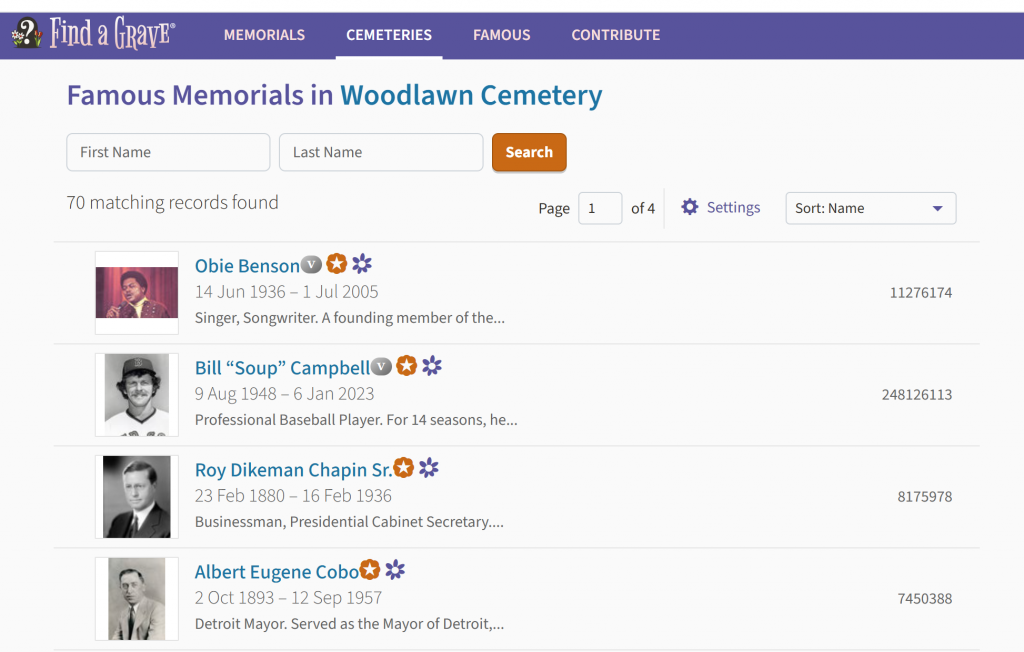
Best of all, some of this research has already been done for you. Genealogical sites like FindaGrave already feature sections for “Famous” interments in cemetery properties, and most community websites include sections on local celebrities. Why not use this to your advantage?