
She Was Gone for 130 Years. This Funeral Director Brought Her Home
We’ve all heard the old saw: it’s not what you know, it’s who you know. Usually, those words taste of sour grapes, but knowing someone who can help you in a pinch is as valuable as any knowledge as you can acquire. In those cases, it’s not just who you know, it’s what they know. That is particularly the case in the story of Dawn Nelson, a funeral director who helped 19th-century journalism pioneer Lisle Lester find her way home.
Nelson, managing funeral director for family-owned Zacherl Funeral Home, wasn’t acting in her professional capacity when she first heard Lester’s story. In fact, she heard the story third hand, but it’s a captivating story that also fell into her wheelhouse both as president of Soroptimist International of Fond du Lac, Wisconsin, and as a funeral director.
When Nelson ascended to president, she wanted to expand the group’s women’s history efforts beyond having the occasional speaker at the library. She asked the history committee to refocus their efforts in promoting local women’s history. They decided to make the talk an event, a luncheon featuring a prominent local historian. It was to be a community outreach project instead of a fundraiser. Ticket prices would cover the cost of the speaker (Tracey Reinhardt) and the food.
Making the Connection
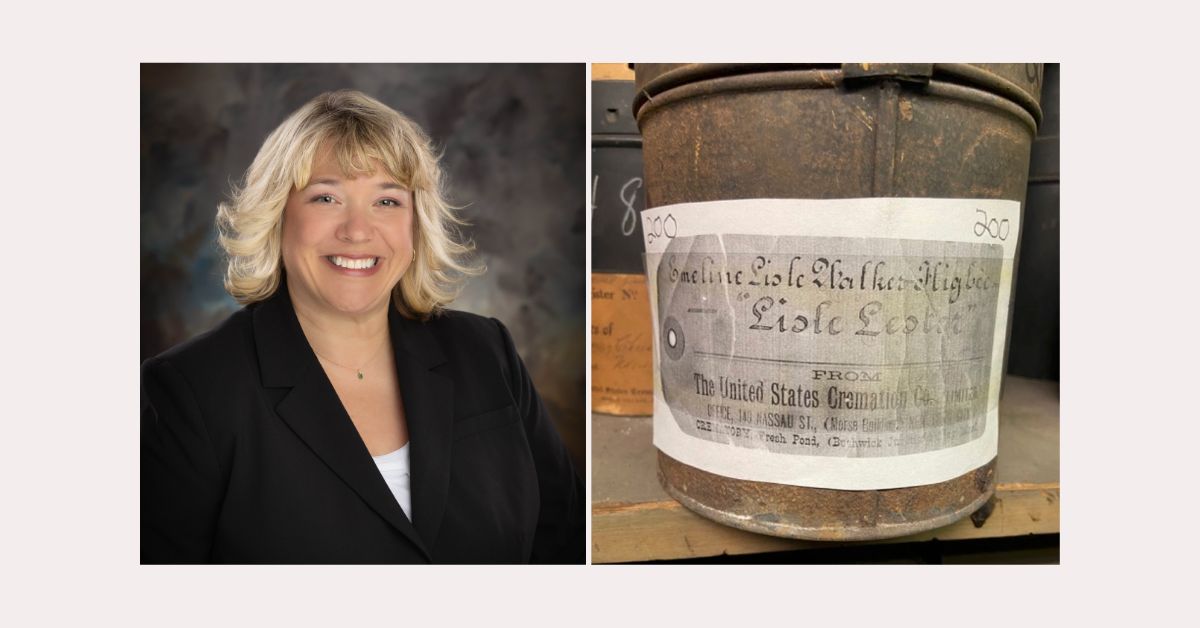
As it turned out, the inciting incident for our story was rooted in a Soroptimist library presentation two decades prior. During her talk, Reinhardt recounted the story of Lisle Lester (born Sophia Walker, June 19, 1837), a local woman who founded the state’s first magazine (The Badger State Monthly) and went on to have a spectacular career. Unfortunately, bad luck and illness left her penniless in New York, where she died alone in 1888. Lester had an indigent disposition by Fresh Pond Crematory in Middle Village, she was the 200th cremation the company did.
Almost as an addendum to her talk, Reinhardt said that in 2003, the Soroptimists requested Lester’s cremated remains for a hometown interment, but Fresh Pond wanted $8,000 in back storage fees. It was more money than the group could even imagine raising at the time. They put the project (way) on the back burner, where it remained until the story reached Nelson’s ears.
Now, I don’t need to tell you that unclaimed remains are a huge issue for most funeral homes, and many are more than thrilled to have a family show up and show interest. Nelson knew this. She also knew that $8,000 to ship the unclaimed remains of an indigent from the 1800s, was absurd.
So she called.
And called.
Nelson made little headway with the first few (male) funeral directors she reached, so finally she asked if they had women on staff. The female director she spoke with was markedly more helpful, in that she actually brought the request to the president’s attention. Joseph Di Troia, who has worked there just shy of 60 years, was not nearly as worried about collecting the $8,000 in back storage fees as Nelson’s predecessors had been led to believe (he waived it).
He was, however, concerned about just mailing cremated remains to whomever asked for them. This response made perfect sense to Nelson. Di Troia put her in touch with the cemetery’s lawyer, who recommended someone local to help with the work. The group had to verify that no family existed that might lay claim to the remains and also agree to provide permanent placement. Nelson was both grateful for the opportunity and a little astonished they found the remains at all.
A Historic Coincidence
“Honestly I think it’s so cool that, to Fresh Pond’s credit, they have all that history still there and they have it documented. I mean to have things documented from 1888 is so impressive,” Nelson said. “I give them so much credit for being so careful about keeping track of everything … I said, ‘Please, before you send these cremated remains to me in a proper container, take a picture of the container that she was in, just for historical purposes.’ They had a labeled metal bucket with Lisel’s full name on.”
The group raised the money, did the legwork, and put the whole thing together over the course of a few years. They had hoped to bury Lester with her parents, but the cemetery had some, let’s call them stringent, demands, so the group kept looking.
Eventually, a different place, Calvary Cemetery agreed to bury the remains in the “old” (Calvary opened the year after Lester died) section of the cemetery and donated the plot. They also offered a deep discount on the memorial, which the Soroptimists are working to raise now.
The Soroptimists planned a celebration of life and final interment for this fall, ensuring plenty of time to make proper arrangements. Since they essentially chose Saturday, Oct. 17, at random, you can imagine Nelson’s surprise when she heard about the inaugural National Cremation Placement Day.
“I was at the Cremation Association of North America conference in Minneapolis this year, and when they announced that that was going to be the same day as we had scheduled for the memorial service and the burial, I was like, ‘This is so cool!” Nelson said. “We did not plan for that total coincidence. It’s just meant to be.”