
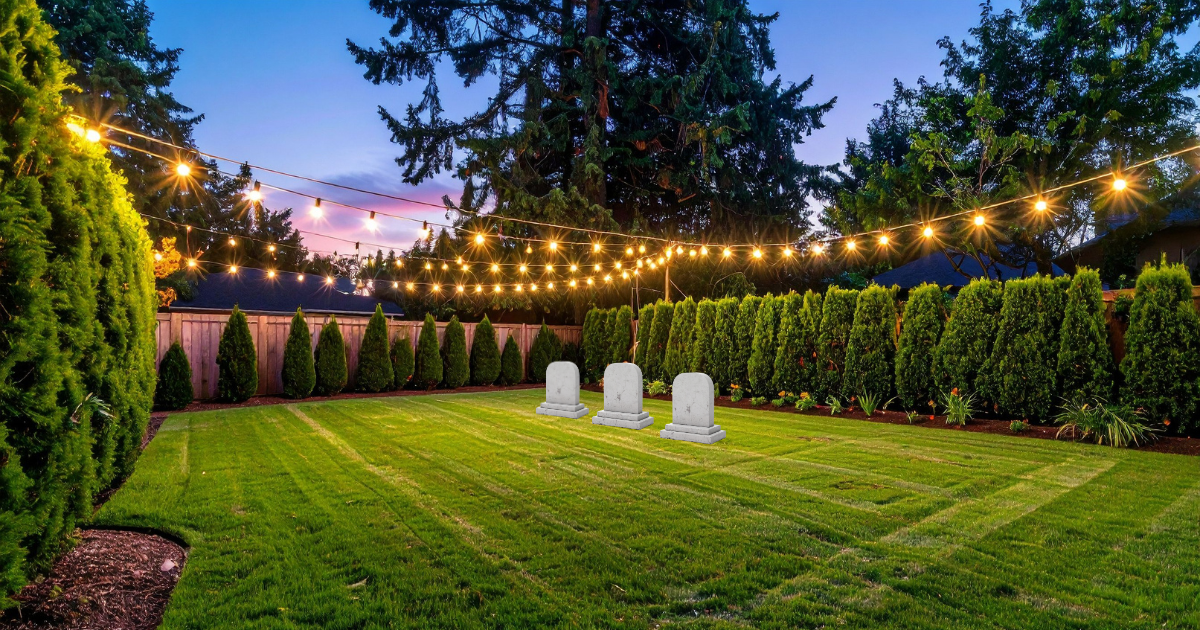

Washington State Finally Legalizes Private Property Burial
Funeral directors in the state of Washington have a new reason to celebrate. As of June 11, they can join their colleagues in 47 other states by telling families it’s finally ok to bury a beloved family member in their backyards.
Washington’s House Bill 2239 makes the Evergreen State one of the last in the country to allow families to establish burial grounds on their own private land. The bill passed in March 2026 with little to no opposition, according to the Washington Cemetery and Funeral Association, and was signed into law. It finally crossed the finish line after more than three years of the bill dying in committee; a previous iteration, HB 1037, passed the House twice before stalling in the Senate.
Washington was, until now, one of only a small handful of states that effectively prohibited burial on private land altogether. Under existing law, human remains had to be interred in a legally designated, corporation-registered cemetery. Families who wanted to carry on the tradition of burying loved ones on their own land were, as Representative Drew Hansen put it when an earlier version of the bill passed the House, doing so in legal uncertainty. Now they have a path.
The fine print (and there’s a lot)
This isn’t a free-for-all, though. According to Washington Funeral Resources & Education, HB 2239 comes with stipulations around zoning setbacks and county reporting requirements. Based on the framework the bill was built on — closely modeled on earlier drafts that were extensively debated — families looking to establish a family burial ground can expect to navigate a few practical constraints.
The burial area is capped in size relative to the total parcel, and must maintain minimum distances from property boundaries, easements, and environmentally sensitive areas like wetlands. Burials must be reported to the county, including names, dates, and GPS coordinates. The land designation is strictly non-commercial — no selling plots, and no operating as a cemetery. And if the property ever changes hands, the seller is required to disclose the existence of the burial ground to prospective buyers. (That last one alone might give a few rural real estate agents some interesting listing conversations.)
Local governments retain authority to regulate or restrict family burial grounds through zoning — which means a rural parcel will have a very different experience than a residential lot in Spokane.
Rooted in tradition
Here’s what’s worth noting for context: for most of the country, this was never a particularly radical concept. Forty-seven states allow burial on private property in some form, though ten of those require a licensed funeral director to be involved in at least part of the process. Washington, California, and Indiana had been the outliers — the holdouts where families who wanted grandma buried under the oak tree behind the barn were out of luck, legally speaking.
The cultural tradition behind the practice runs deep, particularly in rural communities and among immigrant families for whom land burial carries religious or ancestral significance. Rep. Jim Walsh, who championed multiple iterations of the bill, framed it plainly: “Washington families should be able to bury loved ones who’ve passed away on privately owned land. It’s a tradition with deep cultural roots.”