

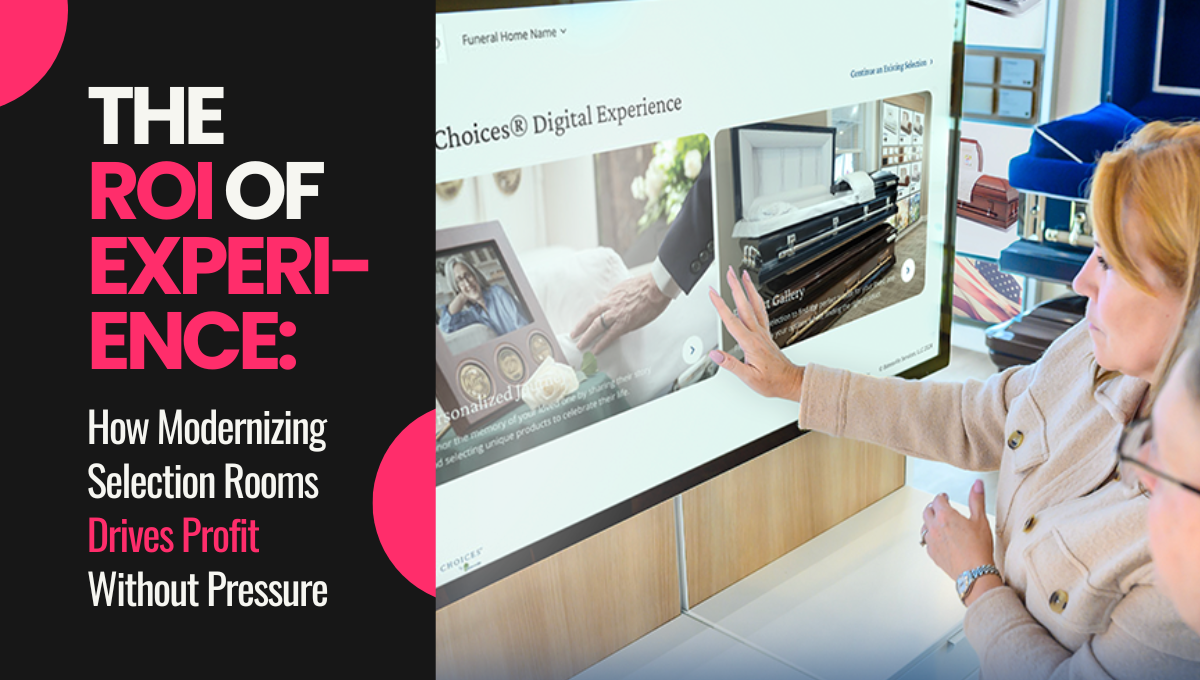
Funeral directors don’t love talking about revenue in the context of grief.
It feels uncomfortable. Transactional. Misaligned with the mission.
But during the Funeral Professional Webinar Series (FPWS) webinar, Meeting Modern Expectations: Redefining the Consumer Experience, one reality stood out:
How families experience your process directly influences how your business performs.
Jenn Parvin of Batesville and Devin Dardanes of B+N Industries both underscored the same point: when the consumer journey is thoughtfully engineered, financial outcomes follow.
Not because you push harder, but rather because the path forward feels clear.
Experience Drives Economics
Consumers behave predictably across industries.
When they can:
- See personalization in context,
- Interact with options visually,
- Transition smoothly between online exploration and in-person conversation, and
- Understand pricing and product differences quickly …
… they make decisions with greater certainty.
Uncertainty stretches conversations, but certainty shortens them. And pace matters.
When arrangements move steadily instead of stalling, personalization increases. When personalization increases, average sales rise.
That isn’t a sales strategy. It’s a presentation strategy.
Clarity Changes the Conversation
Parvin shared that firms integrating digital and physical tools are seeing measurable improvements in both revenue and margin performance.
The reason isn’t pressure. It’s clarity.
When families can visualize engraving, finishes, materials, and customization options, rather than imagine them, perceived value grows.
When perceived value grows, investment follows.
Traditional selection environments often rely heavily on verbal explanation, while modern environments allow families to see and compare.
Seeing accelerates understanding. Understanding accelerates decisions.
Operational Design Impacts Performance
There’s another layer that doesn’t get talked about enough: workflow.
Disconnected systems slow teams down. Re-entered information creates room for mistakes. Outdated display setups extend arrangement conferences beyond what’s necessary.
Modernized environments create continuity between tools and space.
Preferences entered online appear during arrangements.
Product comparisons are intuitive.
Information flows instead of being recreated.
That consistency reduces delays, tightens processes, and improves overall efficiency.
Efficiency is not about rushing families. It’s about eliminating unnecessary steps.
The Hidden ROI: Staff Confidence
The webinar also touched on something less obvious but equally important: team performance.
When systems are cumbersome, staff compensate with extra explanation. When environments feel cluttered, conversations become heavier.
Upgraded environments simplify that burden.
They create structure.
They create predictability.
They create rhythm.
And rhythm improves execution.
When staff operate inside clear systems, service feels stronger and more composed.
That composure translates to better outcomes across the board.
Modernization Is a Performance Strategy
It’s easy to frame consumer experience as branding. It’s not.
It’s operational strategy, and that influences:
- Arrangement duration,
- Personalization adoption,
- Improved product selection,
- Staff efficiency, and
- Error reduction.
The firms referenced during the FPES session aren’t modernizing for appearance. They’re refining the mechanics of how families move through the process. And when the mechanics improve, results improve.
The Business Case Is Clear
Intentional experience design strengthens performance.
When families understand their options immediately, momentum builds.
When systems communicate seamlessly, execution tightens.
When environments support decision-making, outcomes stabilize.
None of that requires high-pressure tactics.
It requires thoughtful structure.
The firms investing in integrated digital and physical systems aren’t commercializing funeral service.
They’re strengthening how it operates. Experience doesn’t sit outside performance.
It shapes it.
To hear the full breakdown from Jenn Parvin and Devin Dardanes, including the operational impact and real-world results, the Meeting Modern Expectations webinar replay is available on demand at Batesville.com/webinar, exclusively for funeral professionals. Log in or register for an account to access it through the Batesville resource center.
Because this isn’t about theory.
It’s about how your firm operates tomorrow.