

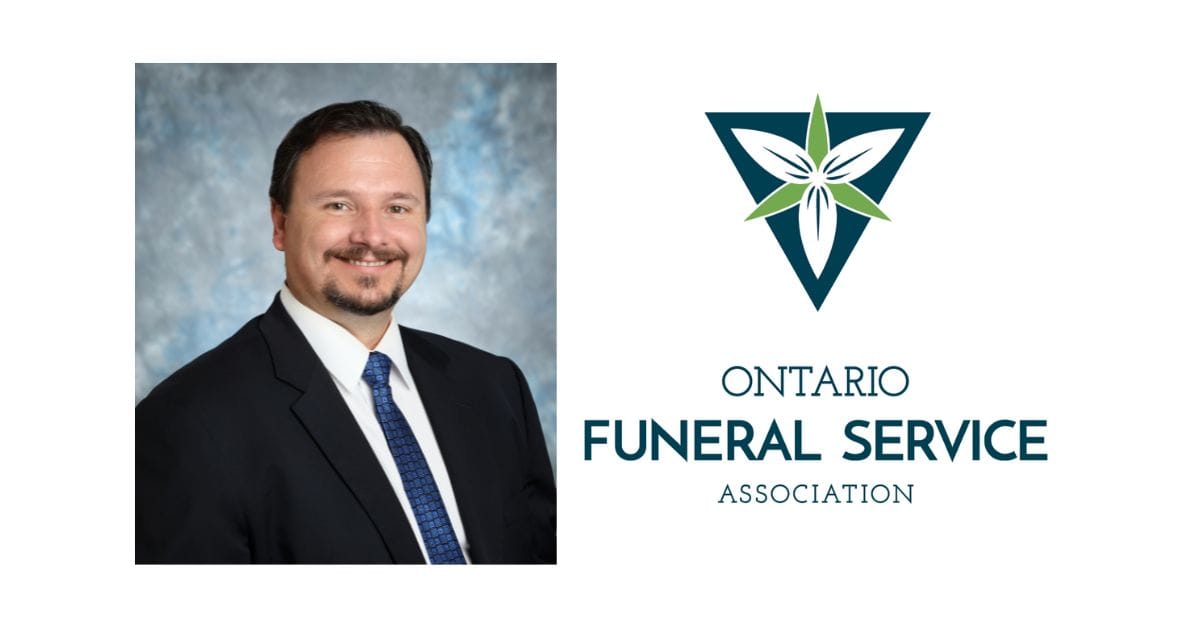
It’s probably no surprise that, as with many other cultural and economic issues, the employment crunch in Canada is similar to what’s going on in the U.S., but also a little different. Recently, Brad Jones, president of the Ontario Funeral Service Association, was interviewed in the Toronto Star about the Ontario deathcare workforce crisis and how the industry there is coping. We spoke with him to get a better sense of the issues from an industry standpoint.
Ontario’s funeral service sector is facing a profound demographic reckoning. As the province’s aging population expands and a wave of retirements approaches, industry leaders warn that a widening talent gap threatens the future of community deathcare.
Jones, a veteran funeral director with nearly 35 years experience, told me that the crunch is driven by a combination of shifting career paths, high retirement rates, and the physical demands of the profession.
Over the next decade, the industry expects to lose roughly 3,000 employees in Ontario as a large portion of the workforce reaches retirement age. Approximately 34% of the province’s funeral service sector is currently 50 years of age or older. Meanwhile, traditional training pipelines are only projected to produce about 2,200 new entrants, leaving a significant deficit.
“There’s going to be a bit of a gap in the next 10, 15 years,” Jones said. “If we can’t get more people interested in the program and good quality people who want to do this, that’s, I think, where we’re gonna find the problem in the future.”
Compounding the labor challenge is the broader economic landscape. While fields like automotive and steel manufacturing have faced structural shifts and closures, funeral service offers a steady, recession-resistant career path. However, attracting talent remains an uphill battle, particularly in rural communities where younger workers often seek the lifestyle and amenities of larger urban centers.
“There’s not a whole lot of interest in a lot of (urban) young people moving up to a small town in Ontario and not having all the restaurants and entertainment that they’re used to,” Jones said. “It takes a special type of person that wants to live in a rural community.”
Educational Shifts and Financial Pathways
Unlike in the United States, where high mortuary science tuition and subsequent student debt often create steep financial barriers, Canadian educational costs are comparatively modest. Students typically incur between $10,000 and $15,000 in combined debt for school and housing. So the debt to salary ratio isn’t a factor the way it can be here.
To further ease financial strains and accelerate workforce entry, the OFSA, in collaboration with the Bereavement Authority of Ontario (a provincial regulatory body) have started offererin concurrent internships. This allows students to complete their practical training while still enrolled in school.
“Students that are in school can be doing their internship at the same time, which fast tracks them through the process to getting their license,” Jones said. “It also helps them that they can make some money while they’re in school, so it takes a little bit of that financial crunch away from them.”
Also, as in the U.S., demographics of those entering the field have also shifted dramatically over the decades. Programs in Ontario now see classes that are roughly 70% female and 30% male, a near-complete inversion of historical numbers from 35 years ago. Furthermore, the sector is seeing an influx of second- and third-career professionals entering the field in their mid-to-late 30s or 40s, bringing valuable life experience to the profession.
Real Estate Pressures and Changing Service Trends
Urban centers face unique infrastructure challenges. In cities like Toronto, rising property values have occasionally outpaced the commercial valuation of funeral home operations, leading several multi-generational facilities to close their doors and sell off the underlying real estate.
At the same time, consumer preferences continue to evolve. Ontario’s cremation rate sits at approximately 75%, placing it well ahead of many American jurisdictions. While direct cremations help bypass service backlogs, they have also altered the traditional timeline of memorials. Families frequently choose to delay services for weeks or months, creating a complex logistical balancing act for funeral directors juggling unpredictable scheduling.
“You have a family that decides they wanna have a memorial service in, you know, three weeks, so you have that booked,” Jones explains. “But then you have a family that two-and-a-half weeks later has a death take place and they want to have their service immediately. So, it, it, it makes a little bit different of a logistical nightmare for funeral homes”
Outreach and the Path Forward
Addressing the deficit requires more than regulatory adjustments; it demands proactive community engagement. Jones emphasizes that the industry must better articulate the deeply rewarding nature of death care, framing it not just as care for the deceased, but as essential support for the living.
“As an industry we just need to do a really better, better job of explaining what we do, like get into the high schools and go and meet students and go to job fairs and tell people what we do like try and. Hire students even if it’s just to help out in the parking lot or lobbies,” Jones said. “Because you never know when someone’s gonna find something that they’re interested in.”