

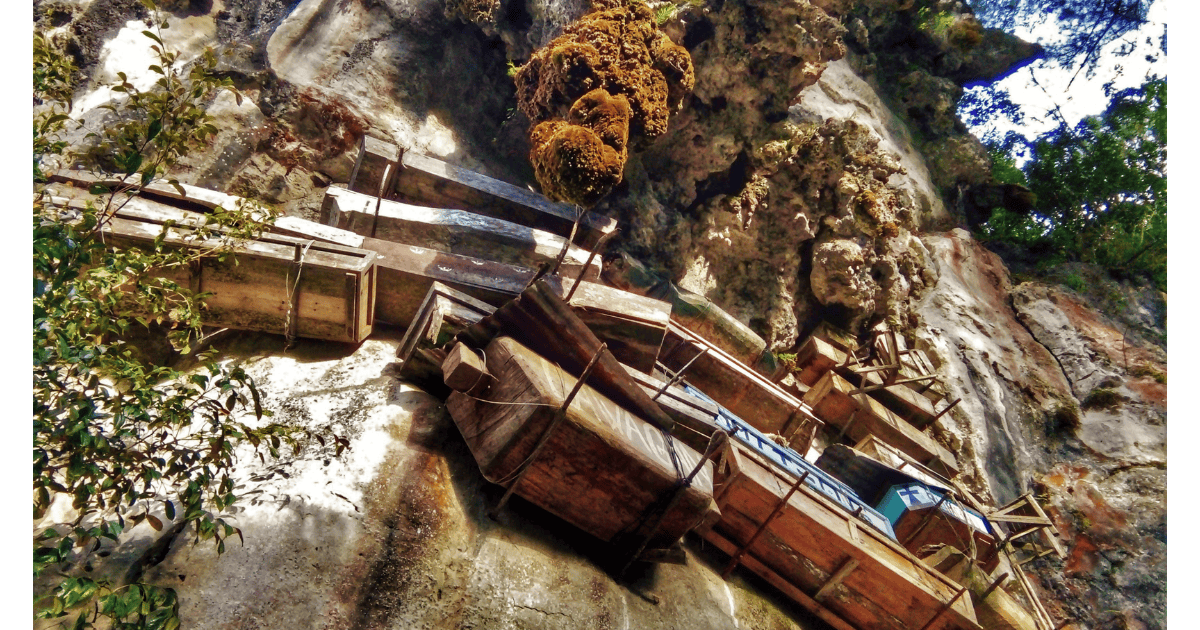
Last week, the fascinating results of two unrelated coffin-related research projects based in China circulated through the news cycle. There’s no doubt that these discoveries offer significant cultural and ecological insights. However, they also provide fodder for deeper deathcare discussions into the sanctity of human resting places and how far science should dig (literally and figuratively) to further such studies.
Climate change and cliff coffins
The first case arises from a major new archaeo-genomic study of China’s “hanging” or cliff coffins that was recently published in Nature Communications. By studying the DNA of the inhabitants of these wooden coffins, which have been suspended on the sides of cliffs and caves for about 3,000 years, researchers have found “the strongest evidence yet” that practitioners of this distinctive funerary custom are direct ancestors of a living community in southwest China: the Bo.
Researchers sequenced whole genomes from 11 ancient individuals recovered from four hanging-coffin sites in Yunnan and Guangxi, added four log-coffin genomes from northwestern Thailand, and compared these with thirty whole genomes from people of Bo descent living today. Their analyses show a clear genetic affinity between ancient hanging-coffin populations and the modern Bo, indicating that “present-day Bo people derive a substantial proportion of their ancestry from practitioners of the Hanging Coffin mortuary tradition.”
The second coffin study, which also took place in southern China, doesn’t seem to be as intrusive, as the ancient pine coffins may not have been occupied at the time they were selected for research. For this study, the results of which were published in the Proceedings of the National Academy of Sciences (PNAS) journal, researchers used the 2,000-year-old wood from Qin–Western Han dynasty coffins “to build a ring chronology (a dated sequence of tree growth) that tracks droughts and wet spells.” The data reveals that “China was roughly one-fifth wetter around 2,200 years ago. That was wet enough to support expanding farms and a growing empire.”
Is there a problem?
Unearthing ancient buried remains for the sake of science is nothing new; the mummies that fill the archaeological or natural history museums are proof of that. Today, though, even those museums are rethinking whether displaying “mummified human remains” (the new, politically correct term) disrespects the dead.
Also, the results of these studies may very well add to the encyclopedia of human knowledge. Now we know that China is getting less rain than the land received more than 2,000 years ago, so maybe in another 2,000 years they’ll be another one-fifth dryer (i.e. climate change is happening, at least from millennium to millennium). We also know that the people who live in the area where one might find ancient cliff coffins are descendents of those who are buried in them.
But does this king of research open the door to other studies — perhaps those performed expressly for curiosity’s sake? Is there a “cut off” age where it’s ok to unearth remains for research (outside the realm of lawful exhumations). If so, what’s that date? Over 1,000 years ago? Pre-1800s?
Something to consider
For deathcare professionals, perhaps, this research has three immediate implications regarding ownership, ethics, and simple respect.
First of all, no one really “owns” interred human remains. They are considered quasi-property. Typically, though, the right to possess, care for, and direct the disposition of remains generally falls to the closest living relative (next-of-kin) or someone designated by the deceased, while the cemetery operator owns the land and the burial plot, selling only the right to use the space for interment (an easement). The family holding the burial rights controls who is buried there and what happens to the remains, but the cemetery maintains the grounds and enforces rules. So who should provide permission for researchers to dig up a grave from, say, a colonial era churchyard to further research of some biological theory?
Even if disinterments aren’t happening in property designated as a cemetery or burial ground, who is ensuring that the process, purpose, and the handling and preservation of human remains are proper and ethical? The dead don’t lose their dignity just because they’ve been buried for decades.
How you can help
If you happen to work with cemeteries, museums, or municipal heritage offices as a deathcare expert or consultant, it might be worthwhile to ask whether local heritage plans include descendant consultations for aged burials, ensure they support site stabilization and non-invasive documentation before further disturbance, and to encourage them to include in their work interpretive materials to reflect the purpose of their research, why it was necessary, and what lessons were learned.
These research subjects are still humans, and there are stories intertwined with their burials. Deathcare professionals must be part of the ethical, culturally informed response.

