
Antonio Green’s FuneralBot.AI Fills in the Gaps and Does What You Don’t Love to Do
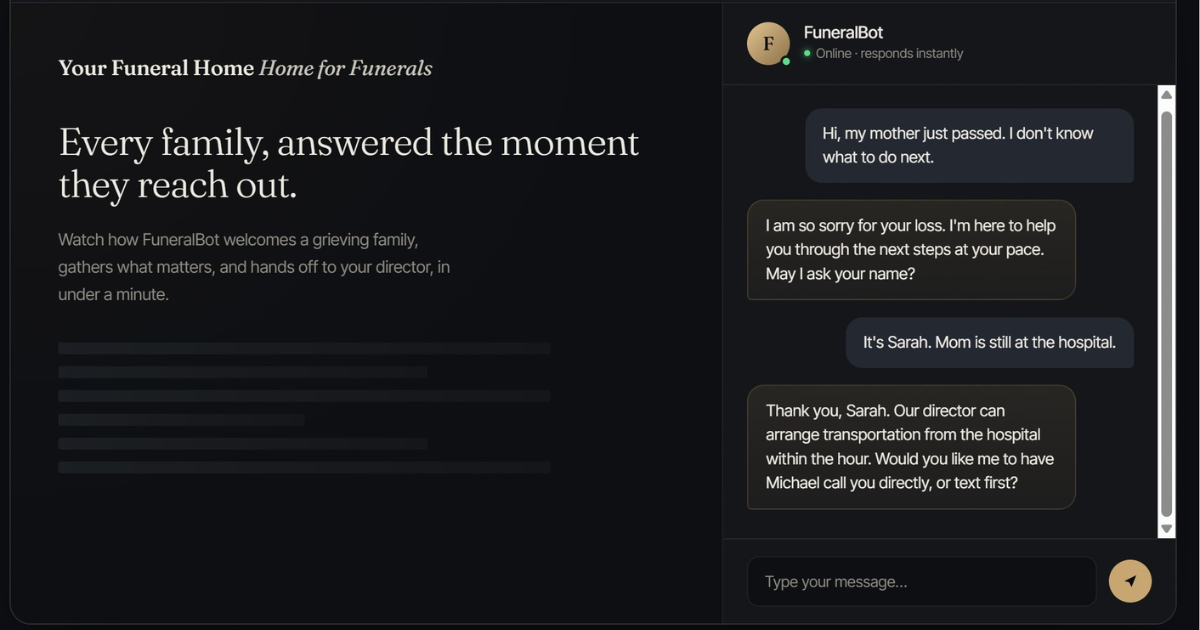
Our friend Antonio Green is not one to rest on his laurels. While he serves families as a fourth-generation funeral director and general manager of James H. Cole Home for Funerals in Detroit, he has also published a book, created a successful consulting service, and shared his insights with other deathcare professionals across the country. Now, he’s funneled experiences and his expertise into FuneralBot.ai, a system designed to help funeral teams spend more time with families and less time on time-intensive tasks.
Filling the software gaps
Green introduced his new tool during the closing session of DISRUPT Media’s and Connecting Directors’ 2026 Funeral (un)Conference, explaining how FuneralBot came to be — and the origin story might not be what you think. He didn’t hand a list of requests to a programmer and ask them to create a solution. Instead, he sat down with a publicly-accessible AI system (Claude Code), taught himself to build software with it, and came away with a tool designed to hand back time — not replace the people doing the work.
Green’s initial commands for Claude were pretty straightforward: fill the gaps left by funeral home case management systems. For example, case management systems track a case well, but most don’t help a firm stay in touch with a family after the arrangements are made — the follow-up emails, the “we’re still here for you” check-ins that keep families feeling cared for long after the service.
“We have all the case management systems and different companies that run those,” explains Green, “but there’s no real CRM [Customer Relationship Management] system that gives people the ability to send emails out [to the family after the fact].”
That’s where FuneralBot comes in. It automates condolence emails at 30 days, 90 days, six months, and the one-year mark, pulled straight from an API connection with Passare or your preferred program, so nobody on staff has to retype a family’s contact information by hand.
“FuneralBot basically provides all the outreach that you could send to a family that you would otherwise need a full time person to do,” Green adds. “It automates aftercare.”
AI for everyone
Green isn’t a developer, but he’s been exploring AI for a while, feeling like deathcare didn’t have much of an on-ramp beyond obituary-writing tools. That changed when Claude Code became available. He pointed it at his own consulting website, Help Bridge the Gap, had it review the whole site, and rebuilt it on a new platform. Now small updates (like adding social media handles to the homepage, which he did ten minutes before walking onstage) take minutes instead of an afternoon logged into a website builder.
The embalming report tool he demoed at the (un)Conference came from the same intersection of need and curiosity. The tool allows embalmers to talk through a case out loud while you work. It sorts the details onto the report your particular state requires, saving you 15 or 20 minutes of paperwork. It started as something Green built just for his own team to try, but it will soon be an optional add-on inside FuneralBot.
A handwritten touch and a text-friendly option
FuneralBot also sends sympathy cards written in a genuine handwriting style through Handwrytten, a service that uses real pens guided by robotics. Since his firm handles a high volume of cases, Green built in a simple filter so the automation stays financially sustainable.
“With our volume,with over 2000 cases, if we’re sending that to everybody, that might get a little expensive,” he explains. “I added a filter where if they meet this threshold, if they spend X amount of dollars, then it’ll send them the handwritten card. So we can basically make up for that revenue. I would say 60% of our families get those handwritten cards. And again, that’s all automated. It’s nothing that anyone has to do.”
In addition to written correspondence, Green has added a text messaging feature to FuneralBot to serve those in his audience who prefer this method of communication. He’s found that families are often more comfortable sharing feedback — good or bad — over a quick text than by calling and leaving a voicemail.
“Now you have that feedback loop so you can constantly know, ‘Okay, what are we doing right?’” Green says. “‘What do we need to tweak before it becomes a big issue?’ Because a lot of times you can jump on stuff right away before they go to Google and leave a bad review. Or you can ask them for a good review if they text and say everything really went well. ‘Oh, we’re so happy to hear that. Whenever you have time, if you wouldn’t mind just clicking this link and leave us a Google review so that text and the text piece’,”
A team member currently monitors that inbox and responds personally, though the system can be set up to answer routine questions on its own if a firm wants that.
Support, not a stand-in
So many of us are still wary of AI — and rightfully so, with all of the gloom-and-doom “replace your job” predictions floating about in the media. But tools like FuneralBot prove that AI can play a significant role in deathcare; in fact, the right tools used the right way can make your job a little less stressful, giving you more time to do the things that only you can do.
The (un)Conference panel on AI plainly made the same point — this technology isn’t here to replace the heart a funeral director brings to a family, and it never will. What it can do is take on the tasks that pull you away from that work: the repetitive follow-ups, the paperwork, the outreach that a solo director or a small team (or, in Green’s case, a high-volume operation) simply don’t have the hours for.
Give it a try!
Antonio Green is already fielding demo requests from firms who learned about FuneralBot from his (un)Conference session, and he’d love to show you what FuneralBot can do — and what it might do in the future, as Green is already planning new additions to the FuneralBot suite of features. You can request your own 15-minute demo here: https://funeralbot.ai/demo.