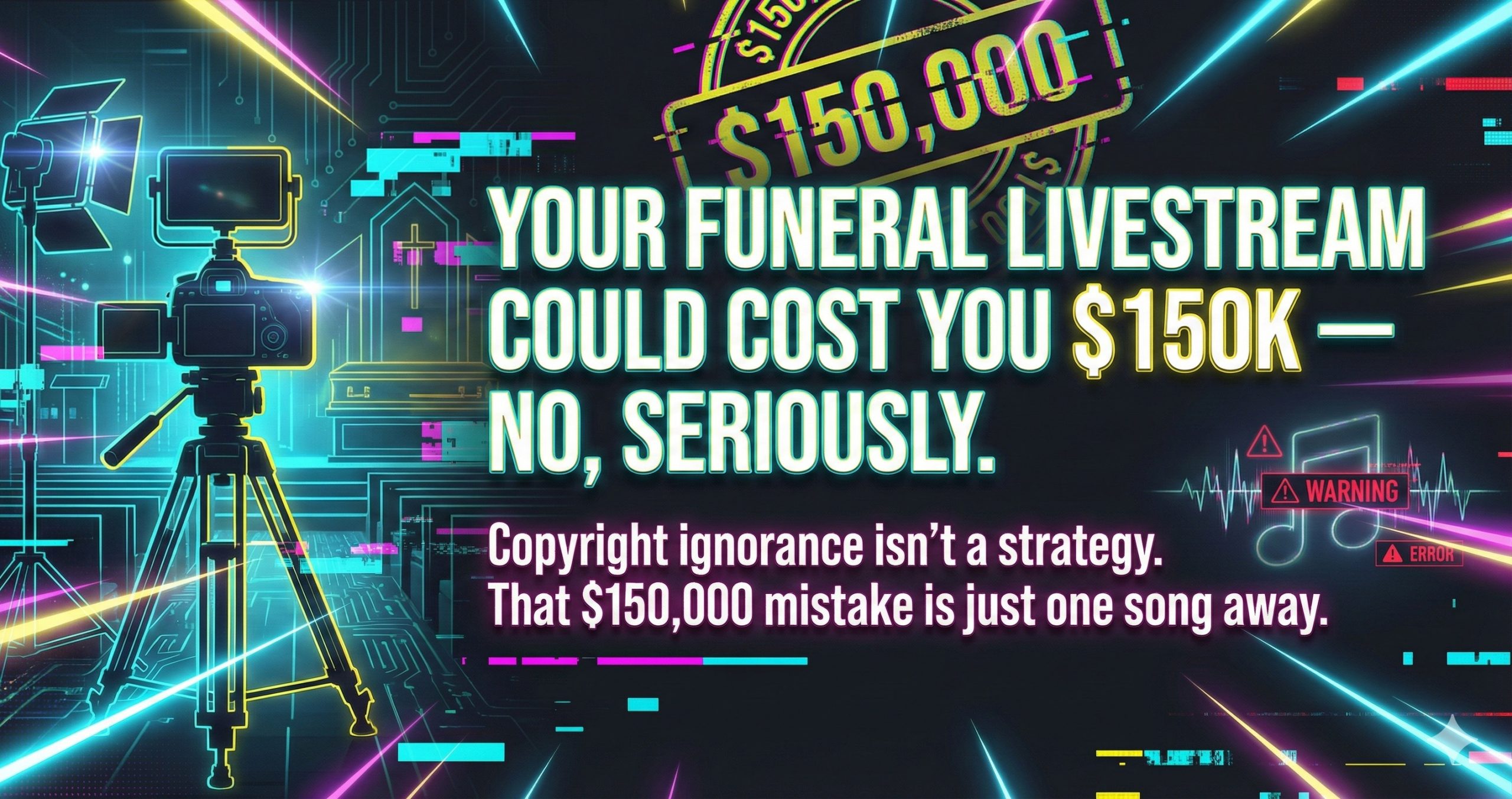

Your Funeral Livestream Could Cost You $150K – No, Seriously
Thousands of funeral homes are still streaming services the wrong way, and it could cost them big. Here’s what you need to know before you hit “Go Live.”
The $150,000 Mistake Hiding in Your Chapel
Picture this.
You’re serving a family. Aunt Linda in Florida can’t attend the service, so you decide to help. You prop your iPad on a tripod, hit “Go Live,” and start streaming.
The family plays Grandma’s favorite song, maybe Garth Brooks or Celine Dion, and everything feels fine. You’re helping people connect. That should be all that matters.
Copyright law sees it differently.
“As soon as that music is recorded on video, you’re in violation. If you are doing it intentionally, that’s when the fine can hit, up to $150,000 per violation.”
— Justin Whatley, CRO, OneRoom Streaming
Every service you record, on any platform,every upload with background songs creates legal exposure most funeral homes have never even thought about.
But Wait… I Paid for a License
Most funeral homes assume they’re covered because they pay NFDA, ICCFA, BMI, or SESAC.
Yes, those licenses allow music to be played inside your building and to live stream it.
They do not cover recording the service with that music.
As Whatley explains:
“You can play the song during the service because you’ve paid for that license. But as soon as it’s recorded, even on your phone, that’s a copyright violation.”
Hitting record moves you into a different category of copyright law. Most funeral homes are stumbling into that category unintentionally.
Why This Risk Is Bigger Than You Think
The financial fine is one thing. The reputational damage is another.
Funeral homes spend decades building trust. All it takes is one copyright claim or one flagged livestream to jeopardize that.
Imagine telling a family that their loved one’s service video was removed due to a copyright issue. Or worse, that your firm received a legal notice. It’s embarrassing and avoidable.
The classic excuse, “We’ve been doing this for years and no one has said anything,” is exactly what gets small businesses blindsided.
The Solution: AI and Compliance Working Together
The good news is that this problem can be solved.
OneRoom Streaming has built AI-powered systems that protect funeral homes while giving families a seamless experience.
Whatley explains their approach:
“We livestream the service, record it, then run AI across the recording to identify copyrighted music. The AI mutes those sections, and we create a custom playlist the family can listen to through YouTube or their personal Spotify orApple Music accounts., .”
This preserves the emotional impact of the music without putting the funeral home at risk.
It’s smart.
It’s compliant.
And it’s exactly what the industry needs.
Livestreaming Isn’t Optional Anymore
Since COVID, livestreaming has shifted from a convenience to an expectation.
Families rely on it. Out-of-town relatives depend on it. Many families revisit the recording during their grief journey and as a digital keepsake for years to come.
But expectations come with responsibility. Using platforms with no compliance option is no longer acceptable.
If your setup still looks like an iPhone on a tripod, it’s time to modernize. Livestreaming is not a side feature anymore. It’s a professional service, and it carries both legal and brand implications.
How OneRoom Simplifies the Whole Experience
The beauty of OneRoom’s system is that it removes pressure from the funeral home. They handle:
- Pulling obituary data to schedule a stream
- Customer support for both viewers and homes
- Automatic backups
- AI detection of copyrighted music
- Playlist creation
- Closed captions
- Chaptered video playback
Key Moment Sections
No director needs to troubleshoot camera issues or angry family calls. No more worrying about whether the livestream will work.
It’s the opposite of the early COVID scramble when “livestreaming” meant hoping someone’s niece could hold a phone steady.
Why All This Actually Matters
This is about more than avoiding a lawsuit. It’s about serving families at a higher level.
Families want a clean, high-quality streaming experience. They want recordings they can revisit that feel intentional, not accidental. They expect convenience, clarity, and professionalism.
And that professionalism directly affects revenue.
“Funeral directors are scared to charge because they don’t know if they can perform. We take that burden off their shoulders so they can charge confidently and deliver every time.”
— Justin Whatley
When directors know the stream will work, they stop being afraid to price it appropriately.
Bottom Line: Stop Rolling the Dice
Livestreaming isn’t going anywhere. Neither is copyright law.
Before you hit “Go Live,” ask yourself:
- Is this platform compliant?
- Am I protected if music plays?
- Does anything in my workflow rely on “I hope this is okay”?
If your honest answer is “I think so,” that isn’t enough. Hope is not a compliance strategy.
A single song can trigger a very expensive mistake.
Final Thought
You can protect your business and serve families at the highest level. You just have to treat livestreaming the way families already do: as a crucial part of the funeral experience.
In this profession, reputation is everything. Don’t risk yours over a song you didn’t even choose.