

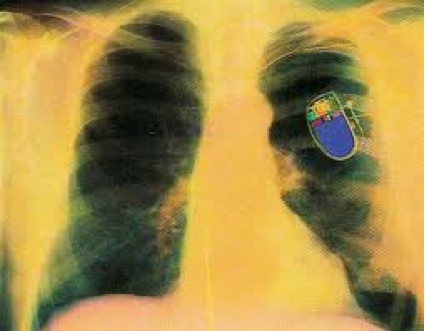
Earlier this week I said that that the 2012 ICCFA convention was the most productive convention I have ever attended, and part of the reason is for the great conversations I had with others in the profession. One of the most intriguing conversations I had was with a newbie to the profession and to the ICCFA convention. Seth Heine is the President and CEO of Refinext, a company the provides responsible end-of-life services for the destruction and reclamation of electronics, medical devices and related materials. Basically the conversation I had with Seth was about the process of breaking down and recycling toxic medical devices like pacemakers. Honestly, I never knew there was an issue here, and I have since learned that neither do most funeral directors.
After a length conversation with Seth I felt strongly about the importance of bringing this issue to light in the profession. Seth recently put together a short blog article centered around one conversation he had with a funeral professional at the ICCFA convention last month. With Seth’s permission the article is posted below. I would love to hear your thoughts on this issue.
Article By: Seth Heine, Refinext
In a recent discussion with a funeral director at the International Cemetery, Cremation and Funeral Association (ICCFA) event in Las Vegas, I had a conversation that went something like this:
Me: “Does your company generate electronic medical devices, such as pacemakers?”
Funeral Director: “Yes, we sure do.”
Me: “What do you do with them now?”
Funeral Director: “We throw them out, as medical waste…”
Me: “Oh no! We can help you do it far better than that – others have been using our free recycling services and excellent reporting to document their destruction. Problem solved!”
Funeral Director: “That’s OK, we’ll keep throwing them away, less paperwork that way…”
Though we went back and forth from this point, the man was not to be persuaded – he was determined to keep throwing the devices in his trash, even though that was neither in his nor his community’s best interests.” It reminds me of the Kermit the Frog line “Its not easy being green”; the funeral services industry is ready to become a responsible green industry. It may have a long way to go, but has a lot of incentive to do so… As I heard one fellow put it recently “Being Green is part of making families feel better about loved one’s deaths.”
The Funeral Services industry has been cautious in embracing new practices; understandable given the conservative nature of the business and the circumstances of grief, consolation and not wanting to create waves during such sensitive times in customer’s lives.
Why is electronic medical device recycling important? Electronic medical devices are chemically similar to electronics such as computers and cell phones; they contain toxic heavy metals (Lead, etc). Consequently, the EPA has a long standing advisory that they should not be buried, land-filled, or otherwise improperly disposed of. That means they should not be buried or treated as medical waste (where they are crushed/burned, causing explosions in the processors facility and presenting other safety problems). Most states have laws in place to prohibit the improper disposal of electronic devices because they are the primary entry point of toxic heavy metals into our landfills. Improperly disposed of, they threaten our water systems.
It got me thinking about the ethics of being green and what that means in the framework of this industry… What does it mean to be a funeral home director, responsible for the beauty of a cemetery, and yet you are knowingly and systematically burying toxic waste with and in the bodies of your customers’ dearly departed? That would honor neither the deceased nor the land. Is it a defensible business decision to save a few dollars knowing that you have buried toxins and poisons that will last hundreds if not thousands of years in the community?
In defense of the funeral services industry, electronic medical device recycling wasn’t really possible until recently, when Refinext’s electronic medical device systems were perfected to the point that we could de-construct, destroy and reclaim these devices. Even their manufacturers weren’t capable of recycling the devices, so in partnership with the world’s leading manufacturers we co-developed systems to safely dismantle and destroy them.
Electronic medical device removal is a simple, quick procedure practiced already by most funeral homes and mortuaries in the context of a cremation; removal in the case of cremation-bound cases is an act of self-preservation – otherwise these devices explode. So why is it different in the case of an interment-bound case? Does burying bodies with toxic waste in them honor the deceased more than removing these toxins from both the body and the land? Are there other ethical considerations, or does this simply distil down to a profitability consideration?
To be clear, I am not suggesting that orthopedic implants be removed from cases – that has a far less compelling rationale and no legal implications as far as I know. In general, burying electronic devices is illegal in the majority of states due to the presence of the toxins in these devices.
These devices have a nominal value of about $10 per device for their scrap metals value. Most funeral home directors do not want to be paid for these devices because they cringe at the prospect of having to have a conversation with the bereaved about the value of the devices, how they were recycled, and sharing of the revenues. I can understand not wanting to have that conversation under the circumstances for a few dollars. Instead, most funeral directors prefer the high ground; documentation for safeguarding the community by proper disposal of the devices and perhaps an arrangement to benefit a charity if there are any reclamation proceeds.
Seth Heine is the President and CEO of Refinext, a company uniquely qualified to recycle explanted electronic medical devices. Refinext’s operations are solely qualified to safely deconstruct, destroy and reclaim these devices. Refinext’s services are free. They include certificates of destruction for all devices processed, as well as annual environmental impact statements documenting the CO2 benefits of the recycling activity.

I’ve noticed in this profession that sometimes a problem does not exist until someone creates a company with which to “solve” the perceived problem.
You sound like a lead paint salesman who wonders out loud why anyone needs to come up with a better way to do things… Not poisoning our water and land may sound like contrived solutions to you – but thankfully you are a shrinking minority. I would encourage you to to evolve your thinking to consider the environment Mr. Fluidpusher…
Seth that is Ms. fluidpusher. you can learn more about her here http://fluidpusher.blogspot.ca/ she likes to share her opinions.
That is NOT me.
I have always disinfected the devices and when I have 3 or 4, I mail them to an organization called “Heart to Heart”, which reuses the devices in third world countries. The only cost you have is postage. Families seem to like the idea too.
Great feedback! In fact, Refinext supports this organization and others like it – who have 88%+ rejection rates based on the re-useability of the devices, so we support this organization by safely and properly recycling the fall out devices. We are proud of this relationship, and impressed by the results as measured by lives saved, and environmental protection.