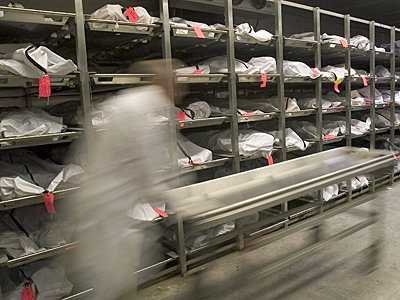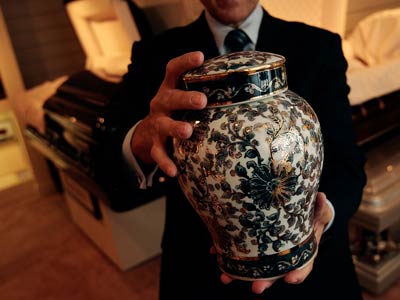
Cremation has become so popular in America that if current trends continue it will be the funerary choice of half of Americans within four years. Time Magazine reported this surprising fact in a recent cover story on the rise of cremation — yet the otherwise probing story omitted, as do many studies of cremation, how the ancient and Eastern practice got its start in America. To understand this requires uncovering a leaf from occult history.
Cremation was introduced to America in the 1870s by a retired Civil War colonel, Henry Steel Olcott. As a Union Army staff colonel and military investigator, Olcott had amassed a distinguished record, which included routing out fraud among defense contractors and making some of the first arrests in the Lincoln assassination. In his post-military life as a lawyer and journalist, Olcott developed a deep interest in the esoteric and paranormal — which drove his fascination with the then-exotic rite of burning the dead.
While cremation possessed ancient roots, it was little known among Victorian-age Americans. Indeed, to most late nineteenth-century Westerners, the concept of cremation seemed otherworldly and even un-Christian. Americans associated funeral pyres and crematoriums with pagan antiquity or the mists of the Far East. Modern people buried their dead, and that was that.
But Olcott saw cremation (mostly) as a commonsensical social reform: He considered it more sanitary than burial, a deterrent to disease, and a help in freeing up land and labor from inefficient burials. And then there was the deterrence of vampirism, which Olcott took seriously. “If any [further reason] were needed by thoughtful persons,” he wrote, “…there are no vampires save countries where the dead are buried.” In Olcott’s eyes the practice had produced such benefits in India, where “we do not hear of Hindu vampires.”
To promote the practice, Olcott organized the nation’s first public cremation service — or “pagan funeral,” as the press called it — at New York’s Masonic Hall on the westside of Manhattan. So controversial was the idea of cremation, that the proceedings on May 28, 1876, caused a near riot and raised cries that the colonel was spreading heathen rites in the city.
But Olcott was accustomed to courting controversy when exposing the public to new ideas. Since leaving the military, he had become an investigator of ghostly phenomena and a globetrotting advocate for the rights of Hindus and Buddhists, whose numbers had been shrinking under colonial missionary campaigns in India and Sri Lanka. Olcott became best known, however, for cofounding, with Russian noblewoman Madame H.P. Blavatsky, theTheosophical Society in New York in 1875. His aim was to seek out and promote occult and esoteric teachings — including the rite of cremation.
In spring of 1876, Olcott found a subject on which to demonstrate the benefits of this ancient funerary rite. A recently deceased member of the Theosophical Society — a penniless Bavarian nobleman named Joseph Henry Louis Charles, Baron de Palm — had willed his body to be cremated. Olcott and his fellow Theosophists rented out the Masonic Hall and offered tickets for nearly 2,000 New Yorkers to witness America’s first public cremation ceremony.
Although the Masonic headquarters featured an impressive auditorium (since gutted when a new Masonic Hall was built on the spot in 1910), it had no crematorium. Nor did any such facility exist in the city. Olcott’s plan was to hold the service and then deliver the body to the newly formed New York Cremation Society, which had agreed to handle the incineration. But the arrangement didn’t quite go as intended.
The day of the service began with an air of tension. A crush of onlookers assembled early at the gates of Masonic Hall, drawn by press reports that promised “a genuine pagan funeral.” Inside the hall, the service turned into a combination of occult pageant and public exposition for the nascent Theosophical Society. Olcott, playing the role of high priest, bestrode a stage that displayed the Baron’s body in a rosewood casket, at the head of which stood a cross with a serpent wrapped around it, spelling out TS, the initials of the society. Seven men draped in long black robes and holding palms surrounded the coffin, while the atmosphere in the hall was filled with Orphic hymns, the smell of burning incense, the flickering of colored candles, and the chanting of mystical incantations.
Olcott attempted to deliver a discourse on reincarnation and the cosmic origins of creation, but his elegy was interupted by shouts from audience members who detected heathenism and heresy. An elderly man rushed the stage and was led away by police. The protestor turned out to be the father of the hall’s organist, thus curtailing the musical portion of the program when his daughter left with him.
Disdainful of stoking controversy, the cremation society that had promised to burn the Baron’s body backed out of the deal. Olcott was left for months with the cost and forensic difficulties of storing a decaying corpse — a task he handled rather deftly by having it encased in dried clay, which minimized odor and decomposition.
Brooding on the problem for months, Olcott finally learned of a private crematorium being constructed in western Pennsylvania. After securing the owner’s cooperation, he personally delivered the Baron’s body there on December 5, 1876. The following morning, at the start of a gray and wintry day, the incineration was performed before Olcott, Madame Blavatsky, several fellow Theosophists and friends of the Baron, plus a contingent of journalists and public health officials. Echoing the scene from New York, a local crowd — this time uninvited — gathered outside the crematorium, heckling and hollering while Olcott tried to maintain the decorum of a funeral inside. At 11:12 a.m. the body was proclaimed fully incinerated, at a passage of more than six months from the original ceremony.
Despite the controversies — and perhaps because of them — the cremation affair proved a victory for Olcott: He achieved his goal of publicizing what he saw as a nobler, more efficient funerary rite. And, in time, many Americans came to agree. While New York’s “pagan funeral” is long forgotten, cremations today account for about 40 percent of all American passages. This represents just one way in which ideas introduced by occult movements have transformed American life — and death.
[Source: HuffingtonPost.com]