

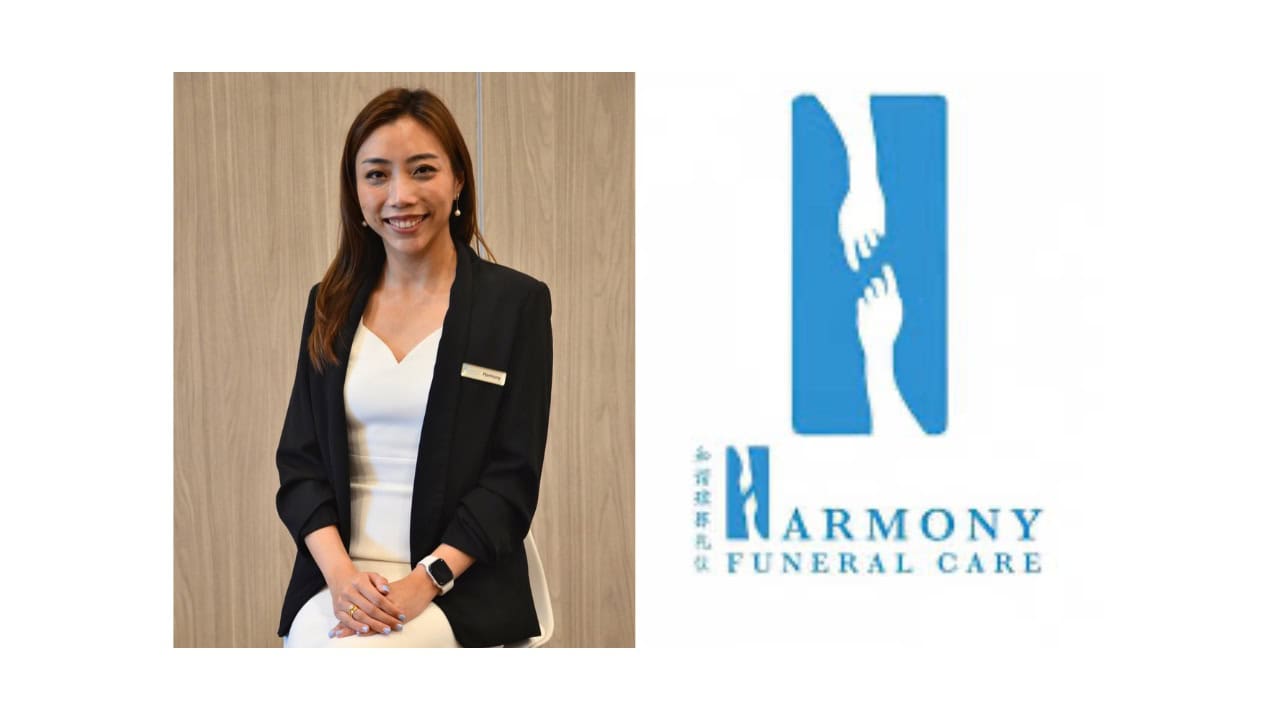
Like pretty much everyone else, third-generation funeral director Harmony Tee works hard to balance a changing industry with some rigid cultural practices and set herself and her company apart while doing it. As a funeral director in Singapore, though, her challenges are different as are the mechanisms available to her. It’s the things that are the same, though, or similar that are worth considering, the universals that likely are common throughout the industry.
The most common one, I think, is the resolution not to take over the family business right up until you find yourself hip-deep in it. Tee’s grandfather started Hock Hin Undertaker, a casket wholesaler, and she got to see the pros and cons firsthand throughout her youth. Naturally, she went into accounting, climbing rung after rung at Ernst & Young until it was clear she wanted more out of her life and career.
Tee didn’t shy away from funeral service because of the hard work and bananas hours so much as not wanted to be too bound to tradition. Eventually, though, it occurred to her that not only wasn’t she bound by perceptions of the past, she was also free to change those biases.
“Having grown up around the funeral industry, I also knew that there were many things that could be done differently. I felt there was room to make funeral services more transparent, professional and approachable,” Tee said. “I also didn’t like how people tended to look down on funeral directors or associate the profession with something unlucky. At the end of the day, we’re providing an essential service, and I wanted to change how people viewed our work.”
When Tee founded her own funeral business nearly a decade ago, things were much different then they are today. Undertakers dressed more casually, with just a white shirt and black pants. The aura was more about the functional aspect than the aesthetic. Today funeral directors dress with more of an emphasis on the seriousness of the job than the function of it.
Wakes, Night Guards, and Stairs
Although the cremation rate is more than 70% in Singapore (over 90% if you exclude the burial-forward Muslim population), embalming still is a common choice. You see, a public viewing in Singapore is VERY public, and lasts three to seven days. Apartment buildings there are, in a way, vertical cities with the lobby acting as a kind of indoor public square. It’s used by anyone in the block who needs a large open space to entertain. That is where wakes are held. People who don’t choose embalming are effectively choosing a closed casket.
“There are no gates whatsoever, so people do have to watch over the body at night. This gave rise to a job called a night guard for funerals,” Tee said. “You literally have people coming at 11 p.m., staying through the night while the family go home to rest, and then at 7 a.m. the family comes down and the night guard’s job is done.”
If it’s a lot less private, it’s often more communal. Imagine if someone in your neighborhood died and you couldn’t help but pay your respects because the wake was held (essentially) on your street. Setting up in those ground-level spaces is fast and portable: funeral directors bring in chairs, tables, and the setup within roughly two hours, and the space itself is free.
There are some “funeral parlors” which cost around $1,800 a day for a dedicated wake space (and that’s before embalming, transport, manpower, or the casket are even factored in). Since the public square is free, it’s the preferred locale. Still, crowding happens when multiple older neighbors in the same block pass away around the same time, which can be tough since there’s no air conditioning and average temperature is in the 80s.
It is the rare family that chooses a more private funeral in their homes, especially if they live on one of these housing blocks. Tee told me a story about the difficulties that come when a family elects to have the casket brought up into their house. She said it tended to happen with people of Indian descent. The difficulty is, the elevators don’t accommodate a casket, horizontally anyway.
Because standing a coffin in a lift can be undignified, Tee has staff who will carry the casket up the stairs, floor by floor, and then back down again when the service is finished.
Land Limits and the Future
As with a lot of European cities, Singapore doesn’t generally have permanent burial. The land lease is usually 15 years and can’t always be reupped. The scattering gardens, though, are a sight to behold. In response to the land crush, the Singaporean government established two massive scattering gardens to accommodate remains when people did not want to keep them at home or scatter at sea (which were the primary non-burial methods of final disposition before COVID).
The gardens opened in 2021. Tee told me that, because of strict government shutdowns, the pressure on funeral directors was greatly reduced during the pandemic.
While funeral directors don’t need licenses in Singapore, embalmers do. Tee has a license and keeps her hand in, but as her company grows she embalms less and less. Growing the company, she said, isn’t that much different than in the U.S. – using social media to make connections with families increasingly is important. Tik-Tok is her preferred medium (we have all her socials below), but she told me she was a fan of Dan Madden, also known as Dan the Funeral Man.
“I saw his Instagram and I followed him when he had a very small following,” she said. “So now that he has grown, it’s so amusing the content that he posts out. It’s so amusing. I can take it really positively, but for the Singaporeans sometimes they do get offended. So I tend to play on the safe side.”
Death-Tok, it seems, is international, which isn’t a shock, but in a world where firms need to distinguish themselves, being the face of your business is paramount no matter where you live.
Even though she’s only in her 30s, Tee wondered at where the business would be in another decade. As with the US, younger people are less religious and much less married to tradition. Direct cremation is still a small but growing part of the business. Oddly enough, the best paid person at traditional funerals tends to be the officiant. “Celebrants” don’t really have a place in Singapore deathcare just yet, but the clergy all command significant fees for their services (which don’t require the same physical and emotional investment as lugging caskets up 15 floors).
As an outsider, the thing that surprised me most was Singapore doesn’t rely on preneed insurance at all, in the way funeral directors do here. Older people still pay in advance, but the price is only good for 10 years, after which time they can either get their money back or pay the going rate for another 10 years. There’s not a lot of incentive for younger people to preplan.
“In Singapore because people want things instantly (Tee responds to the home within an hour of the call), it’s also a very stressful job. I mean I see the purpose in what I’m doing. I really see it as a duty, a calling, to help the bereaved family members. But sometimes it can be really emotionally difficult,” she said. “So we’ll see where this leads us to. I was telling [my husband] that I want to be a pastor or counselor in the future. Maybe when I’m older. I can’t be running this at the age of 60.”