

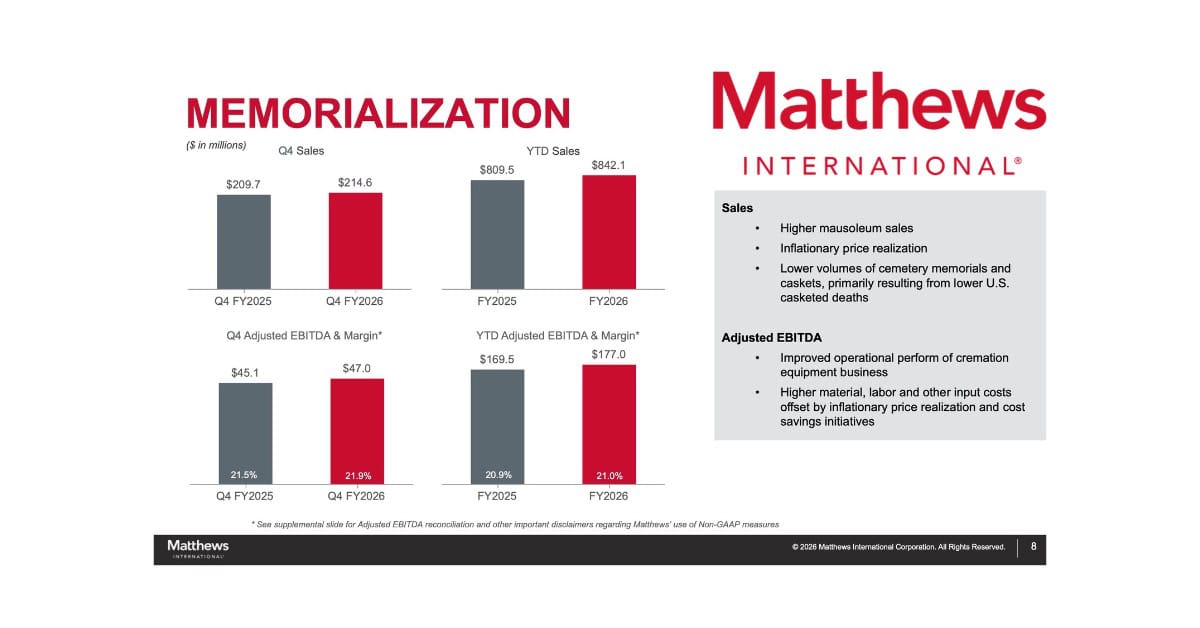
Matthews International’s Memorialization division closed out fiscal 2026 at the top of its game, posting record adjusted EBITDA (up 4% year-over-year) of approximately $177 million on a margin of roughly 21%. Fourth-quarter revenue for the segment reached $214.6 million, up from $209.7 million a year earlier, while fourth-quarter adjusted EBITDA rose to $47 million from $45.1 million.
New President and CEO Mike Whitehead, who took the helm on August 31 after Joe Bartolaci announced his retrement after nearly three decades, called Memorialization the foundation of the company and praised the division for delivering even as estimated U.S. casketed death rates ran lower than normal and inflation pressed on costs. Still, as expected, large cemetery sales were up significantly.
He said that rather than waiting on demographic tailwinds, leadership leaned into pricing discipline, cost savings, productivity gains, contributions from the Dodge acquisition, higher mausoleum sales volumes, and steady cremation equipment sales. Whitehead emphasized that Matthews had a particular advantage in that they aren’t locked into one disposition. Caskets, cremation equipment, bronze, granite, and related memorial products act as mutual hedges as consumer preference changes. He added that cremation equipment ended the year with meaningfully higher orders and backlog.
Memorialization Beyond Deathcare
Whitehead pointed directly to operational complexity across Matthews’ memorialization sites and casting capabilities as key areas to simplify and expand. Having visited most of the company’s memorial facilities in his first two months on the job, he noted that customer loyalty runs deep, even as internal processes leave room for cleaner execution.
“I think there’s a lot of complexity in our businesses. If you look at it from an operations standpoint, I think that we don’t get enough purchasing leverage across the groups. That’s, you know, opportunity for us,” he said. “I think we have complexity in our demand planning. We have complexity in our distribution network. So I think those are all, you know, real opportunities for us to get better from a margin perspective.”
Beyond tightening purchasing, demand planning, and distribution, Whitehead highlighted ways to grow into adjacent markets.
“We don’t do enough in sports and entertainment memorialization, which is a huge market, so there’s opportunity there. But if you take it a step further, we cast aluminum, we cast bronze. There’s an enormous market that we don’t participate in at all for casted replacement parts, and we participate very little,” he said. “The barrier to entry is pretty low. We have the capabilities to do very low volume due to our 3D printing of molds. So we can make two or three a part where most people wouldn’t want to tool up to do that.”
Analysts Zero In on Margins, Casting Upside, and Orders
Analysts repeatedly pressed management on how durable Memorialization’s performance is heading into fiscal 2027, starting with whether the roughly 21% margin can hold and expand over the next one to two years. Whitehead said he feels very good about the current margin and sees upside as management reduces internal complexity and captures better leverage.
“I think the margin profile is sustainable, if not have upside. We’re in the same market as everybody else, see the same thing. So I don’t know that we’re going to see any sort of drastic change in death rates or any massive shift there,” he said. “ So I think that that’s a pretty flattish market, but I would expect that we would grow on the top line. And I would expect that from a margin profile perspective, we’d get better.”
Analysts also asked for specifics on commercial expansion in bronze casting and sought clarity on fourth-quarter order strength after it was mentioned early in the call. Whitehead confirmed that orders in Memorialization were up both year-over-year and in the fourth quarter, reinforcing his view that the segment can grow its top line and improve margins in fiscal 2027 even in a flattish death-rate environment.
The Rest of the Fiscal 2026 Report
Across the broader company, Matthews finished fiscal 2026 with roughly $1.05 billion in revenue, adjusted EBITDA of $161.5 million (including $46.5 million in the fourth quarter), and a fourth-quarter GAAP net loss of $19.5 million, or $0.62 per share, compared with a net loss of $27.5 million, or $0.88 per share, a year earlier. Results reflected major portfolio shifts including the December 2025 divestitures of the warehouse automation, tooling, and European packaging businesses.
It also showed delayed customer spending in industrial projects, tariff and input cost pressures, litigation and proxy defense expenses, and restructuring costs. Industrial Technologies posted $192.4 million in full-year sales and a $16.3 million adjusted EBITDA loss, though Product Identification delivered double-digit fourth-quarter sales growth and profitability while Axion commercialization stretches toward material revenue in fiscal 2028 and energy storage testing continues amid an intellectual property dispute involving Tesla.
“The level of interest remains strong, and we’ve got a lot of testing going on with a number of customers in that industry … The market as a whole has gotten to the point that they want to get their testing and be ready to go when we can resolve the dispute with Tesla,” Whitehead said echoing Bartolacci’s explanation from earlier in the year. “We’re very busy relative to the testing. Unfortunately, people making large capital investments are not going to do it with a large uncertainty hanging over their heads.”
On cash flow, debt, and capital returns, full-year operating cash flow was a net outflow of $58 million, though Matthews returned to positive operating cash flow in the fourth quarter. Divestiture proceeds of $242 million and $28 million from redeeming part of its preferred stake in Propelis helped cut gross debt by $100.4 million to $610.4 million ($584.3 million net debt), with plans to pursue a Propelis exit in 2027 to pay down more debt, simplify its ERP setup, and keep trimming stranded costs. The board also declared a quarterly dividend of $0.26 per share payable Dec. 14, marking the 33rd consecutive annual dividend increase.