


Ask The Expert: Robert M. Boetticher Jr., is a second-generation funeral director and Director of Support for Carriage Services, Inc.. Bob currently serves as First Vice-President and Treasurer for the Cremation Association of North America (CANA). With over 20 years of experience, Bob is a funeral, cemetery, and cremation expert who is dedicated to improving the funeral profession.
Contact: info@cremationassociation.org
Question: What do the CANA statistics mean for my funeral business?
Answer:
For the past decade, I’ve seen funeral homes and cemeteries blame the increase in the cremation rate for the challenges they experience as they struggle to survive in an increasingly competitive environment. Their solution has been to simply wait for something to happen, and then formulate their reaction after the fact.
The reality is that this type of passive response to the consistent rise in the cremation rate in your market is not productive. Without a more proactive strategy, you may face difficult times ahead and possibly have to look at making some really tough business decisions.
But what if you knew what the cremation rate would do in the future? What if you could anticipate how your market will change? Are you interested? I bet the answer is yes—yet there are so many funeral homes and cemeteries across the United States that don’t take advantage of this information even though it is easy to obtain. The cremation data exists and is available to ALL members of CANA.
In service to its members, CANA produces an annual Cremation Statistics Report for the United States and Canada. The report includes the most recent numbers released by the states and provinces as well as projections for what the cremation rate will be going forward. Perhaps the most valuable feature of the statistics is that they have a margin of error of less than .10%. It doesn’t get any better than that.
Just how relevant is this knowledge? Look at any number of published reports and news stories associated with cremation trends—and the data is usually directly linked to the CANA Cremation Statistics Report.
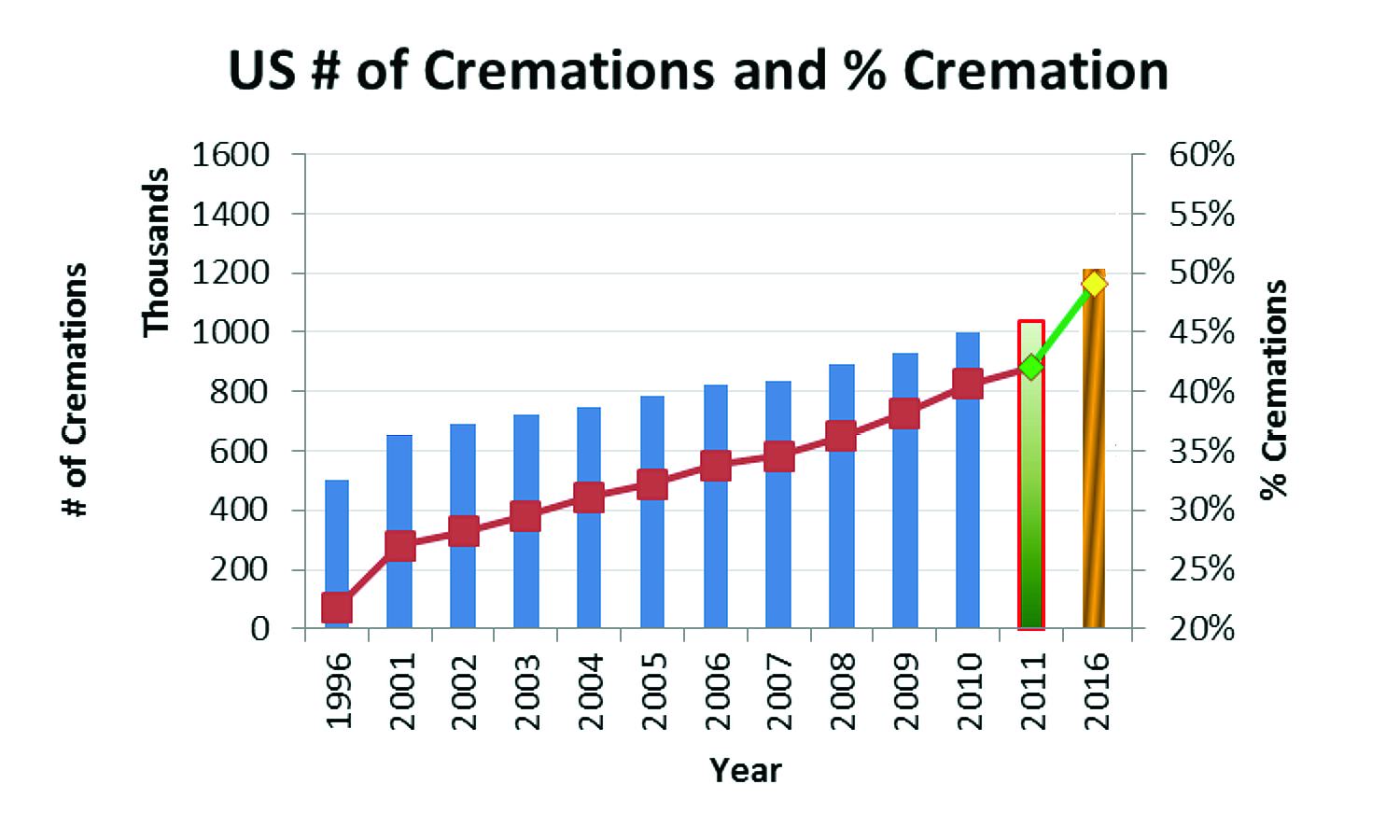
We know for a fact the cremation rate is increasing exponentially, with the U.S. national average increasing 1.68% year over year. By 2017 we will see that average grow to 50%.
In fact, in 2010 not a single state missed out on accruing double-digit cremation rates. The lowest number was in Mississippi, which averaged 13% that year. Many funeral and cemetery professionals are seeing numbers far above the national average. For example, at 85% Nevada will have the highest cremation rate by 2016. The statistics report clearly illustrates the trends on a region-by-region basis, showing the Pacific region leading the way with 61.0% and the East South Central region lagging behind at 23.0%.

The state of California boasts one of the highest cremation rates in the United States. California is also notable for the total number of cremations performed there. In 2010 California was the leader in the nation at 131,140.
There are many reasons for the steady rate of growth of cremation across the U.S. The 2010 FAMIC study lists several, including cost, range of options, geography, religion and tradition.
So the real question is, have you looked at the data and proactively adjusted your business plan to ensure you are ready to thrive in a changing market place? Or are you simply reacting to changes in your market and waiting for the other guy to do something you can copy? Or will you just play the price game—because after all, it’s the reason we see an increase in the first place. If you are doing the latter, I would bet you are frustrated and probably concerned that you are boxed into a business model that no longer works.
Here is a real world example of applying CANA statistics to a funeral home’s business plan.

Cremation and its perceived cost savings isn’t sole reason many of us are being challenged in the profession. I’m here to tell you that one of our biggest obstacles is simply ourselves. We’d rather believe this “trend” will pass and once again all our client families will say, “Embalming and a traditional funeral is what we want.”
Unfortunately, we have already been waiting decades to see if things will shift back while the consumer is moving in another direction. Non-industry professionals are steering toward a new business model that better serves the modern consumer—even as they watch us recede in the rearview mirror. As a matter of fact, many of these new competitors are better educated on this trend than we are with our traditional funeral and cemetery training and outlook. They are proactively reviewing and reacting to the data, involved in association events, and looking for ways to improve their businesses.
There is so much information associated with consumer trends that is relevant to our profession. I urge you to seek out this information, reach out to the experts, talk with your team, embrace change, and shift your focus. You will be glad you did.
 Robert M. Boetticher Jr., is a second-generation funeral director and Director of Support for Carriage Services, Inc.. Bob currently serves as First Vice-President and Treasurer for the Cremation Association of North America (CANA). With over 20 years of experience, Bob is a funeral, cemetery, and cremation expert who is dedicated to improving the funeral profession.
Contact: info@cremationassociation.org

Great article! Any chance we could see some Canadian Statistics?
Would someone please clarify what the “Real World” chart is supposed to tell us? The percentages along the bottom are not labeled.
Beyond that, the math is pretty simple. There will be fewer funeral providers down the road, each serving a larger number of deaths.
The question becomes, where are the break-even points in any particular market that will allow an operator to have a sustainable business. This will vary depending upon local regulation, employment costs, taxes, etc.
That’s the work that still needs to be done. We have to rewrite the financial play books to accommodate 50% + rates of cremation, but so far I haven’t seen anyone publish that work out in the open. Maybe some to the big companies have done some of this homework, but given the multiples they keep paying for funeral homes in my area, they don’t seem to think that cremation matters.
Thanks for a great response. The percentages along the bottom of the chart correspond to increases in cremation rates. The full CANA Annual Statistics Report (including Canadian data) is available to CANA members in the secure section of http://www.cremationassociation.org
I would be curious to know how you arrived at your financial conclusions. Cost structures and profitability can vary widely between regulatory environments and from business to business. Obviously some organizations operate in high cremation zones 60% to 70% which maintaining profitability.
Glad I have my own cremator. At least I’m not paying someone else to do it.
I am curious how cremated remains are presented if the family elects not to select an urn?