
Beyond the Live Stream: 5 Reasons You’re Missing a Huge Memorialization Opportunity
For years, the purpose of recording a funeral service was simple: bridging the distance when family and friends couldn’t gather in person. While streaming remains a critical way of welcoming those who are unable to attend to still be a part of the service, as the ways we honor a life evolve, recording a ceremony increasingly serves as a lasting act of memory preservation.
On the day of a service, immediate family members are navigating deep grief and emotional overload, rarely absorbing every word spoken. Capturing those moments creates a digital heirloom, safeguarding the authentic voices, shared laughter, and quiet tributes so families can revisit and draw comfort from them for generations to come.
We spoke with Maria West at OneRoom about some of the ways funeral homes may be both missing the opportunity to expand their service to families as well as ignoring a vital revenue stream. She explained i
Here are five common ways funeral homes may be missing out on a memorialization option that provides lasting value for families.
1. Assuming the Recording Is Only for Missing Guests
The deepest value of a recording often belongs to the people sitting in the front row. On the day of a funeral, immediate family members are navigating grief, managing social expectations, and processing emotional overload. They rarely absorb everything said. A recording gives them a gentle way to reflect on the memorial when they’re ready to revisit it.
If families have access to some of the kind words or anecdotes that raise a smile, it can help them internalize the good will that was expressed toward them as well as their loved one.
It’s something families can revisit on anniversaries, birthdays, or quiet holidays. For funeral homes, it can enhance aftercare programs beyond a text or note. Sending along well-loved clips from the event can make the contact even more personal.
A video record becomes an heirloom, allowing children, grandchildren, and future generations to hear the voices, stories, and laughter surrounding a life they didn’t get to know as well as they might have wished.
2. Treating the Service as Over the Moment the Doors Close
In-person attendees often leave the chapel wishing they could better communicate a specific tribute, eulogy, or poignant moment with family members who couldn’t be there.
“You should have heard her grandchildren’s tribute,” or “That story his brother told,” don’t have to be stories in the abstract. When a service ends, the connection doesn’t need to. Providing a seamless way back to those memories by, for example, placing a discreet QR code on the order of service that links directly to the recording, transforms a single event into an enduring archive for the entire community.
3. Overlooking the Affect Your Firm Has on Viewers
Online attendees aren’t necessarily distant strangers. Many tend to be local people who aren’t able to attend for a multitude of reasons. These viewers are part of your community. In fact, about one in three online viewers lives in your community.
When remote guests experience a thoughtful, high-quality production, they aren’t just observing a ceremony, they are experiencing the caliber of care your firm provides. As with any other televised event, they’re viewing it through the filters of their own experience. That is, they’re considering what their funeral might eventually look like. These online attendees are the families you will serve tomorrow. Treating their digital presence with the same dignity as in-person seating reinforces your role as a modern community institution.
4. Handing Families a Flat Video File and Calling It a Day
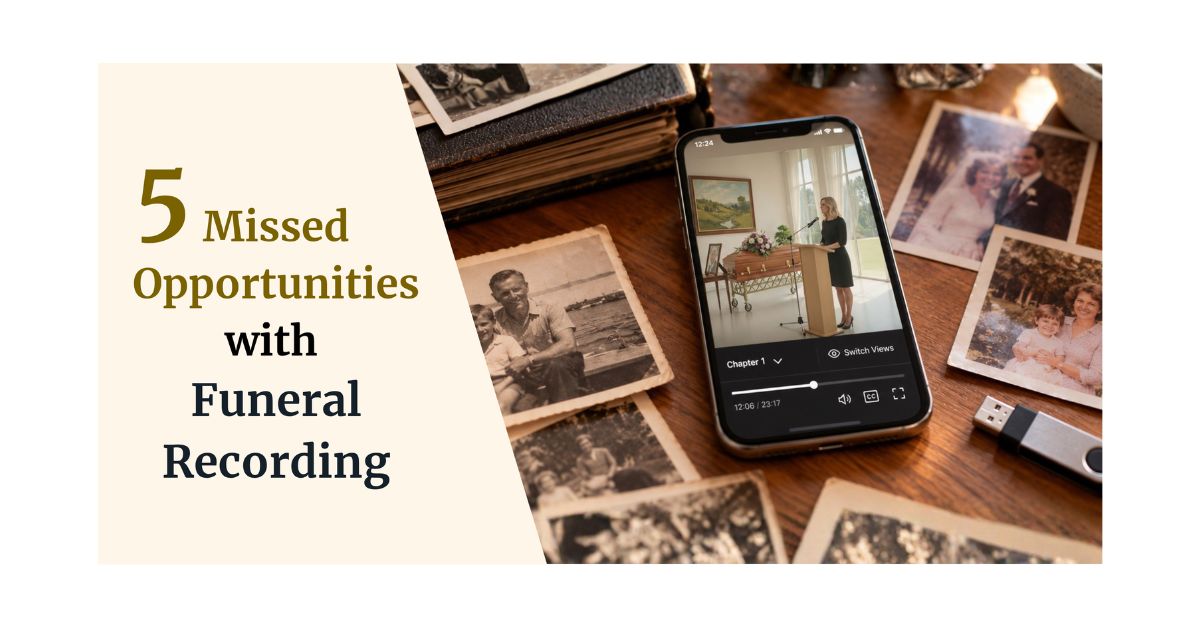
Very few grieving family members want to sit through an unbroken 60-minute video file. When they return to a recording, they are looking for specific, meaningful moments. The idea of fast-forwarding and “rewinding” feels very VCR in a digital world.
A raw video file on a USB drive forces families to drag a playback scrub bar back and forth, hunting for the moment they need. That friction discourages them from returning to the memory.
Platforms like OneRoom allow families to navigate directly to specific moments through tagged chapters, key highlights, and individual tributes. Instead of a file sitting forgotten in a drawer, the service becomes a living archive that is effortless to revisit and share. It allows you to encourage families to think of them as bookmarks in a family album.
5. Waiting for Grieving Families to Request It
Funeral directors often assume that if a family wants a service recorded, they will ask for it. As we know, families are overwhelmed, exhausted, and forced to make dozens of decisions during an arrangement conference. The long-term value of capturing the service rarely crosses their mind in that moment.
Some of the most meaningful things ever spoken about a human being are said inside a funeral service. Those stories, reflections, and spoken words happen once. If they aren’t captured, they disappear forever. This is the kind of offering that should fall under the “every option every time” umbrella.
Funeral directors can guide families the way they would through every other important aspect of memorialization. Saying something like, “We capture this for every family so you don’t have to worry about missing anything, and so your family always has a safe place to return to these memories,” both reinforces the lengths to which you’ll go and opens the door to talking about how they’d like their loved one remembered.
Framing recording as an essential act of memory preservation rather than only an add-on for people who can’t make it, allows funeral homes to help protect moments that can never be recreated.