

It’s not particularly novel to say that cemetery management is, at its core, land management. Private cemeteries, for better or worse, are mostly left to their own devices when it comes to pricing, maintenance, and operations. Public cemeteries have the bonus challenge of also being a public service while being a public expense. Many have professional management but a significant number, especially in smaller towns, can fall under the broader heading of public works.
It’s an interesting tension. Very few private cemetery managers find themselves in charge, “by accident,” as it were. Town managers, or heads of public works, on the other hand, may not have intended to be in the cemetery business, and can run into conflicts beyond their training and preparation.
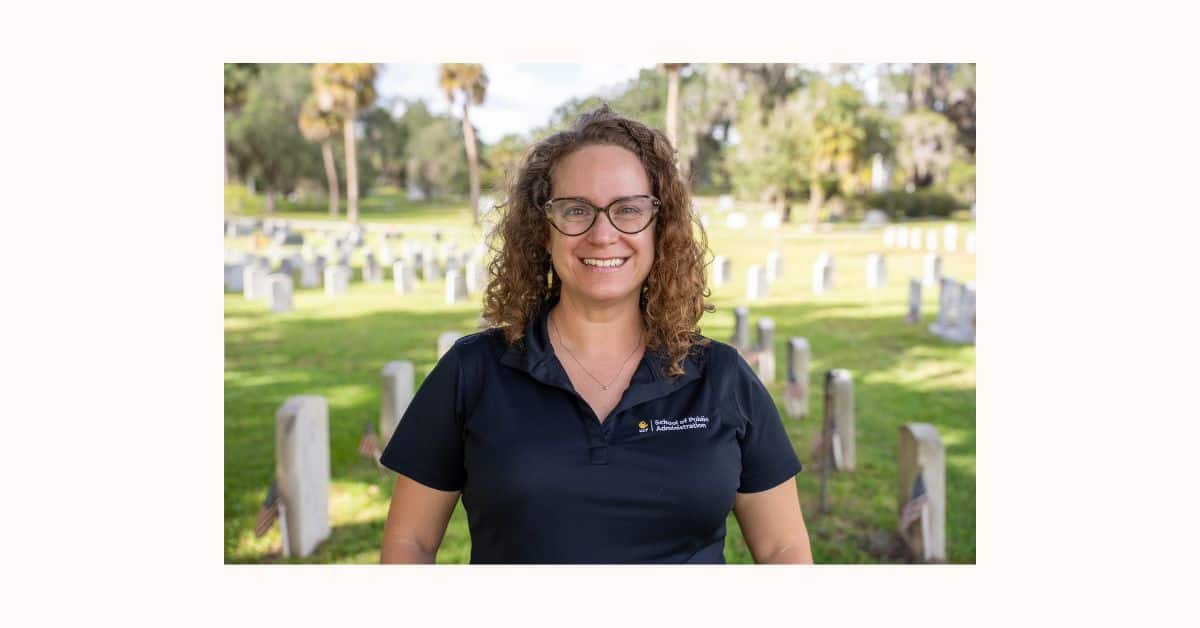
This was one of the questions that occurred to Staci Zavattaro. As a professor of public management at the University of Central Florida in Orlando, Zavattaro never expected to study mortality. Her early research focused on traditional public sector communication. That trajectory shifted completely in the wake of the 2016 Pulse nightclub shooting. When the city asked Zavattaro and her colleagues to interview roughly 40 municipal employees who responded to the tragedy, two specific interviews stood out.
One was with the city cemetery manager, who detailed the complex administrative steps required to coordinate a parade permit just to shut down the street outside the municipal cemetery to protect grieving families from expected protesters. The other was the county medical examiner, who discussed the deliberate, meticulous nature of victim identification. These critical, hidden responsibilities struck Zavatarro as fascinating as well as under-considered.
“I thought, ‘Huh. Can I just learn more? Can I start talking to these folks who have chosen careers where they are surrounded by death and dying every day?’ I started looking into the literature in our field,” she said. While she found lots of stuff on mass casualty and mass fatality, there was little on the day to day. That’s what captured her imagination. “[There was little on] the quote unquote every day management of death. How do these folks show up every single day?”
Over the next decade, she interviewed roughly 70 public servants to understand why people choose these careers.
Technical Realities and Public Tensions
Moving past the initial discovery into the technical realities of municipal operations, Zavattaro found a stark contrast between public and private facilities.
“The one thing I heard repeatedly in my research is money,” she said. “Some municipal cemeteries are totally fine. Some I talked to said, ‘Well, I wish we could sell flowers. I wish we could sell stones. We’re missing so much, of other revenue streams.’”
Some towns don’t want to appear to be running the cemetery at a profit. In many cases, the city council’s prime directive is to keep costs low to be more inclusive. This financial structure creates profound operational challenges. Many towns lack dedicated perpetual care funds, leaving cemeteries reliant on line items in city budgets where maintenance crews are frequently pulled away to mow, say, baseball fields instead. Furthermore, public servants face distinct physical and psychological hurdles when adapting to modern trends like green burials, where handling un-casketed bodies involves dealing with what one New England manager described to Zavattaro as “literal dead weight.”
Navigating Land Scarcity and the Future
Beyond daily maintenance, Zavattaro’s research addresses how public cemeteries navigate land scarcity and shifting community values. As traditional plots fill up, local governments have to maximize remaining land through creative solutions, such as establishing scattering gardens, planning expansions, or evaluating how to accommodate both casketed burials and cremation options.
On the flip side, as people get more interested in alternative dispositions, towns are doing what they can to accommodate, say, natural burial. This is a great example of what happens when people who didn’t necessarily get a job in deathcare have running a cemetery added to their job duties.
“It was really interesting to talk with a municipal cemetery manager up in New England talking about green burial, and what that meant for the safety of their workers,” she said. “There’s really no equipment they need, but bodies are very different when there’s not a casket, and how do you make sure that psychologically, the employees are OK, and physically, they’re OK when, as she said, it’s literal dead weight. You don’t think of these as a problem that public servants are out here trying to solve. It’s not a very visible one.”
She told me another story about a cemetery that was installing a scattering garden. That’s the kind of expense that can be tougher to justify in front of a town council than, say, a regular board of directors.
Ultimately, Zavattaro hopes her work bridges the gap between scholars and practitioners while encouraging people to have necessary, albeit sometimes uncomfortable and very public, conversations about what a public, community cemetery is supposed to be.