
Connecting Directors
  • Home
  • Funeral News
    • Company News & Mergers
    • Association & Regulatory News
    • Legislative Updates
    • Supplier Announcements
  • Community & Culture
    • Lighter Side
    • Grief Conversations
    • Director Spotlights
    • Community Outreach
  • Trends & Innovations
    • Products & Startups
    • Tech & AI
    • Cremation & Aquamation
    • Green/Natural Funerals
  • Professional Guidance
    • Leadership & Management
    • Marketing & Social Media
    • Staffing & HR
    • Customer Service
    • Preneed & Sales
  • Video
    • DISRUPT! Series
    • Interviews & Panels
    • Trending Videos
    • Product Demos
No Result
View All Result
  • Home
  • Funeral News
    • Company News & Mergers
    • Association & Regulatory News
    • Legislative Updates
    • Supplier Announcements
  • Community & Culture
    • Lighter Side
    • Grief Conversations
    • Director Spotlights
    • Community Outreach
  • Trends & Innovations
    • Products & Startups
    • Tech & AI
    • Cremation & Aquamation
    • Green/Natural Funerals
  • Professional Guidance
    • Leadership & Management
    • Marketing & Social Media
    • Staffing & HR
    • Customer Service
    • Preneed & Sales
  • Video
    • DISRUPT! Series
    • Interviews & Panels
    • Trending Videos
    • Product Demos
No Result
View All Result
Connecting Directors
No Result
View All Result
Home Professional Guidance & Resources Leadership & Management

Prions: “Immortal Diseases” Enduring Beyond the Grave

Jennifer Trudeau by Jennifer Trudeau
July 29, 2025
in Leadership & Management, Professional Guidance & Resources
0
Prions
13
SHARES
30
VIEWS
https://www.facebook.com/disruptmg/https://il.linkedin.com/company/disrupt-media

Pathogens that stay viable in the environment for decades after the death of their host, opportunistically infecting whoever happens along, may sound like something out of a horror movie, but that’s exactly what prions do.

Capable of passing from the soil to people and animals for upwards of sixteen years and possibly much longer, prions are incredibly resistant to degradation specifically due to their shape. Other pathogens can hang on similarly after the death of their hosts, with lifespans extending months in certain bacterium of tuberculosis (virulent for nearly three months) and some rare viral hemorrhagic fevers (Ebola, Lassa) that can infect others for more than a week. But no virus or bacterium challenges the longevity of prions, which cause Creutzfeldt-Jakob disease and Gerstmann-Sträussler-Scheinker syndrome in humans and Mad Cow and chronic wasting disease in cattle, sheep, elk and deer. There’s even a human version spread through cannibalism.

Misfolded proteins

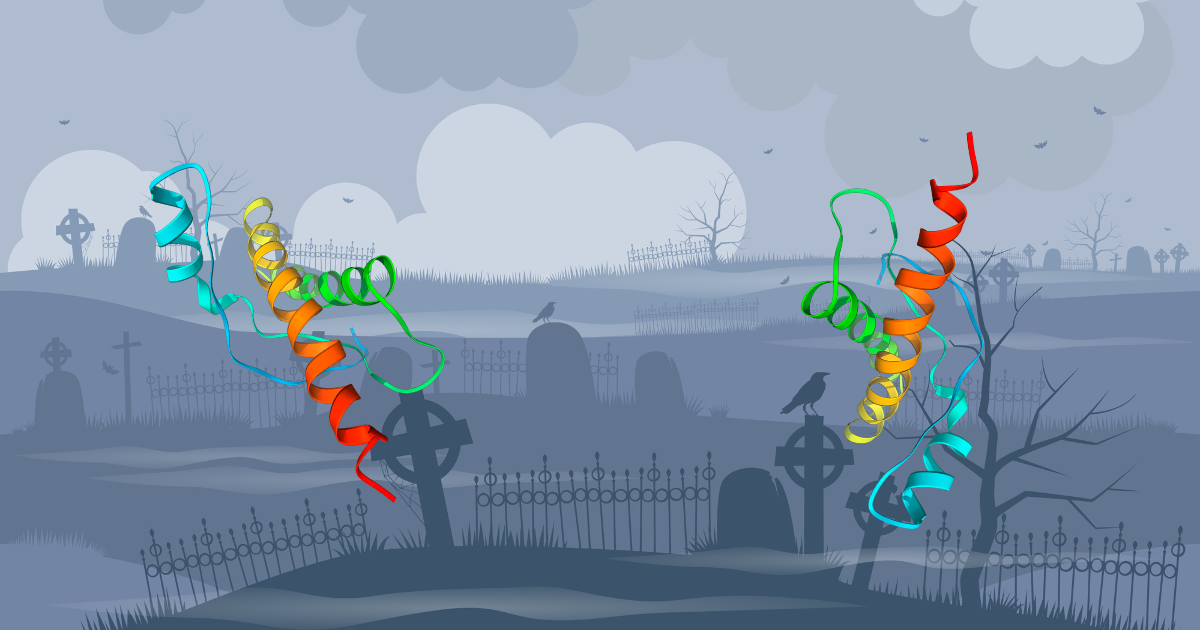
Prion is the term for a treacherous protein with a structure completely different from what it ought to be. Proper proteins, you will recall, are honorable, essential building blocks of life: proteins are what  give us our heart muscle, our blood, our vital organs. Proteins have highly-specific three-dimensional profiles; it is this exactitude of a protein’s shape that gives it its identity. Angularity, precision of detail of form, engenders a protein’s particular powers.

Sounds almost innocuous, then, to speak of misfolding, a word more likely to inspire visions of laundry than reverent dread, but proteins gone wrong take on nefarious abilities. All prions were once common proteins of a type present in most humans and animal cells, but for a number of reasons (oxidative stress, genetic mutation), as they form may take disastrous turns, forming incorrectly. The protein’s structure gets shaped improperly, resulting in a prion instead of the protein that should have been. This prion then goes on to create more like itself, protected be the incorrect shape it has given itself.

The disease moves fast. It’s untreatable and always fatal.

Infection from the soil

Prions may bind to the soil and remain viable, infecting vegetation grown in soil where prion-diseased animals have decomposed; prions can pass through the vegetation to grazing animals, infecting them. Living infected animals meanwhile are moving through the world shedding prions through urine, feces, skin, antler velvet, and saliva.

Ingestion of prions through infected materials, tissues, or meat is one way of contracting the disease from the environment; sometimes livestock have received feed comprised in part of the remains of other infected animals, and contracted the disease this way. For humans — assuming cannibalism is not a factor — proper sanitation is key to avoiding infection where exposure is possible (including consuming meat from exposed livestock).

Destroying prions

There are, of course, many well-established precautions for those in the field of death care who must safely handle infectious remains, such as of those with prion diseases.

Those with the experience will be familiar with the various chemical processes that break down prions effectively, and that application of such methods isn’t practical at scale in the environment.

The safest disposition for infected remains is high-temperature cremation; temperatures above 900 degrees Fahrenheit sustained for several hours will destroy prions.


Jennifer Trudeau
Jennifer Trudeau

Contributor writing on grief, memorialisation and the human side of funeral service.

All posts by Jennifer Trudeau

Related Articles

Leadership & ManagementNew Funeral Home Tax Practice Led by Chris DuncanOctober 5, 2026Customer ServiceA PSA for Funeral DirectorsSeptember 25, 2026Marketing & Social MediaChptr and NFDA Partner for $1M National Radio Campaign Honoring Deathcare ProfessionalsSeptember 21, 2026
Tags: PathogensPrionsScience
Previous Post

Chocolate Factories & Olds Money | 4M #171

Next Post

NGL celebrates team members’ impressive achievements and performance

Next Post
NGL Grit awards

NGL celebrates team members’ impressive achievements and performance

Job Posts Powered By: Deathcarejobs.com

Connecting Directors

Recent Posts

  • Tesla’s Flying Car Announcement Sparks Heated Debate Among Funeral Directors | FFFW 303
  • She Was Gone for 130 Years. This Funeral Director Brought Her Home
  • Not Your Grandpa’s Deathcare Community: Death Rocks Club Opens for Funeral Directors

Categories

  • Association & Regulatory News
  • Community & Culture
  • Community Outreach
  • Company News & Mergers
  • Cremation & Aquamation
  • Customer Service
  • Director Spotlights
  • DISRUPT! Series
  • Friday Funeral Fast Wrap
  • Funeral News
  • Green/Natural Funerals
  • Grief Conversations
  • Interviews & Panels
  • Leadership & Management
  • Legislative Updates
  • Lighter Side
  • Marketing & Social Media
  • Morticians' Monday Morning Mashup
  • Most Popular
  • Preneed & Sales
  • Product Demos
  • Products & Startups
  • Professional Guidance & Resources
  • Staffing & HR
  • Supplier Announcements
  • Tech & AI
  • Trending Videos
  • Trends & Innovations
  • Tukios
  • Uncategorized
  • Video
  • Community & Culture
  • Home
  • Home

© Connecting Directors. All rights reserved.

No Result
View All Result
  • Home
  • Funeral News
    • Company News & Mergers
    • Association & Regulatory News
    • Legislative Updates
    • Supplier Announcements
  • Community & Culture
    • Lighter Side
    • Grief Conversations
    • Director Spotlights
    • Community Outreach
  • Trends & Innovations
    • Products & Startups
    • Tech & AI
    • Cremation & Aquamation
    • Green/Natural Funerals
  • Professional Guidance
    • Leadership & Management
    • Marketing & Social Media
    • Staffing & HR
    • Customer Service
    • Preneed & Sales
  • Video
    • DISRUPT! Series
    • Interviews & Panels
    • Trending Videos
    • Product Demos

© Connecting Directors. All rights reserved.