

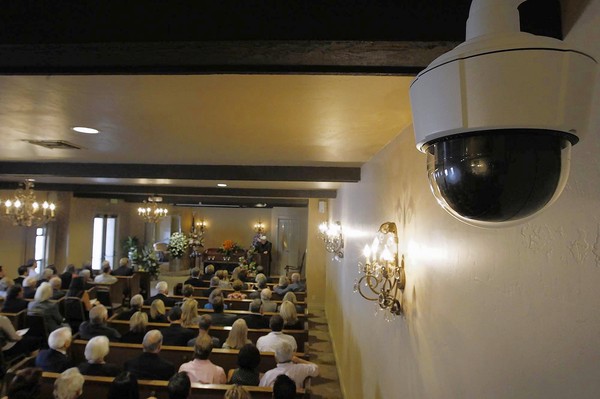
The following article appeared on the Wall Street Journal blog Tuesday. It offers an interesting perspective on the experience of attending an funeral online. The conversation around this topic will be an interesting one because so many people experience death and grieving in different ways that it is hard to determine how valuable of an experience can actually be had. Please use the comment section below to share your thoughts.
The Online Funeral – Article By: Evan Selinger
My grandfather died on Halloween. Thanks to Hurricane Sandy, none of the New York family members could attend the funeral in Massachusetts. Fortunately, another option became available: The ceremony was streamed online, and so my wife, daughter and I gathered around a laptop in our living room to watch the live webcast.
The rabbi began by giving technology center stage, poignantly acknowledging that the virtual participants played an important role in honoring the deceased’s memory. After that, technology receded into the background for the Massachusetts crowd. My grandmother looked like a bereaved widow. Online coverage didn’t affect her demeanor—or anyone else’s.
At my house, however, things were different. The technology raised all sorts of problems and questions.
For starters, there was the initial hurdle of gaining access to the webcast. A password was needed, and we were initially sent the wrong one. After conceding the mistake, the woman in charge of the set-up said that we could just catch the archived footage later on. She was trying to be helpful, but the digital convenience of it all felt completely out of place, as if we were making plans to watch a favorite sitcom later on DVR.
Once the technical difficulty got resolved, we confronted a host of unfamiliar issues of protocol and decorum. Rory, my six-year-old daughter, wanted to know if she could eat while watching. In person, obviously, chomping while prayers were offered would be distracting and frowned upon. But was it actually rude here? And, if we allowed it, would we be implicitly sending her the message that this wasn’t a somber occasion?
When Rory let out a loud “Yes!” followed by an enthusiastic hand gesture as the rabbi said her name when listing the decedents, we weren’t sure what to say. Since the enthusiasm was contained to our house, did the inappropriateness matter?
And what about Rory’s constant barrage of questions? They interrupted our focus, but she posed them urgently, saying that she wouldn’t remember her questions later. Since the funeral would be archived for 30 days, we knew that whatever we missed could be seen later. We certainly wouldn’t have been as indulgent had we been there in person.
My wife and I were also challenged by having to participate by webcast. Viewing everything from home, we felt distant from the choreographed gestures. We didn’t feel inclined to rise when the other mourners did. We didn’t even try to say the prayers aloud.
When the ceremony ended, we quickly returned to our daily routine. Not being physically present for the funeral, we didn’t feel the usual need to reflect, or the usual sympathy and sorrow. We didn’t pass by other mourners and exchange condolences. We didn’t have the spine-tingling feeling that comes from being near a casket containing a beloved relative. We didn’t line up in a funeral procession.
It would be a mistake, though, to say that the webcast dehumanized or even sullied the experience. Convenience always comes with costs, and we didn’t feel that the sacred had been sacrificed for the expedient. Our emotional attunement was limited, but we weren’t desensitized. And it was certainly better than not being present at all.
But how far should technology be allowed to expand the reach of such events? The appropriateness of public displays of grief is now being debated in the context of social media. Some applaud the live-tweeting of funerals for extending the circle of participation. Others find the commentary intrusive. As the novelty fades, I suspect the resistance will as well.
Traditional funerals—to say nothing of weddings, confirmations, bar and bat mitzvahs and other ritualized ceremonies—are intimate encounters that revolve around cherished norms. People readily take offense at perceived violations, but perhaps the time has come to be more open to change. As the digital age continues to expand, new rituals will emerge, confronting us, time and again, with the question of whether old ways are enhanced, diminished or simply altered by new ones.
Mr. Selinger is a professor of philosophy at the Rochester Institute of Technology and a fellow at the Institute for Ethics and Emerging Technology.

I believe that having the option to view the ceremony when unable to attend in person is a great gift that can be given to many grieving family members. However, if the participants fail to properly assess the gravity of the situation, and fail to educate their kids or other participants of the importance of the event, it could easily become a trivial event.
The wonderful part is that a single family/location viewing a streaming broadcast is unable to interrupt the remainder of the group. Therefore, if one audience is disrespectful, it can’t harm the rest. I’ve been in many services where crying babies are instantly rushed out the door (as if crying were inappropriate in a funeral service). The grieving mother of the infant (usually not father) is then forced to miss a portion of the event – which can never be returned. Webcasts solve that problem. Many have said, “I cannot go, my baby is sick.” (or being unruly)
If you can remember that the screen isn’t just another TV program, and you enforce the same rules of etiquette you would if you were there…this is a nice option. By no means should it become the alternative. If you have the ability to go in person, you should go. No matter how much you attempt to engross yourself in the event and follow protocols of a funeral, you will never be able to truly achieve closure if you miss the service when you could have gone. I’m certain that many years later, anyone that chose to take the “easy” route and watch from their couch would begin to feel guilty or unfulfilled with that choice.
For those living in other countries, those that lack the financial means to make a journey of considerable distance, or even those who simply cannot get enough time away from work to make a trip…this is WONDERFUL!
With regard to the privacy and even technical difficulties: 1) User error is common when dealing with things that are relatively new to the participants. This will fade. I apologize that you had to be one in the “growing pains” category of streaming funerals. Perhaps later, you’ll view your issue as par for the course in revolutionizing the option of doing so. Think about the people that first watched a film. If the projector had a hiccup, they still got to be among the first. As for privacy, password protected/invite only events easily overcome the concern. Being honest though, what security do you have at the funeral home itself? Isn’t it possible that someone would “crash” a funeral? I’m pretty sure that I’ve seen that in a movie before.
Many progressive funeral homes and larger churches are offering this service right now, and I think circumstances such as jobs, money and health issues prevent people from attending funeral from far away. What changes “viewing” to “participating” is offering the ability for that grandchild serving oversees to provide a eulogy or share a memory live via Skype at his/her grandfather’s services. The technology is out there and pretty affordable to provide these services. Of course, online funerals should never take the place of attending when it’s possible. As funeral directors, we need to affirm the value of the gathering whenever we can. And we should only incorporate technology when it is actually purposeful and not for the sake of just having it.
This is a beautiful way to memorialize a loved one. Some people, however, still don’t get it. Back in 2006, I couldn’t get the memorial service on CCTV when I put my mother to rest. The funeral director was surprised that I even wanted to have it videographed. He was way out of touch. I hired my own videographer, who did a fantastic job of recording the service, and later, sent me copies of the service on a DVD. The FD was so backwards with this, that I had to record the eulogy into a vintage tape recorder, when I learned that he didn’t even have a decent sound system. Thank goodness the videographer had decent sound equipment. He (videographer) later said he had never before received a request like this. But I followed my heart and knew that it was the right thing to do. I shall have this memory forever.