

Brook Reutter and Ana de la Torre have partnered on plenty of projects over the years, mostly on affordable housing and other endeavors in support of Tulsa’s Hispanic population. Not too long ago, she came to him with a very specific proposition. They would both get into a business they knew very little about because the Spanish-speaking population was, according to de la Torre, woefully underserved.
Ana de la Torre’s realization came out of a place of deep personal grief and frustration. After experiencing the sudden loss of a loved one, she found herself navigating the immensely complex process of transporting a body across the border to Mexico. Between endless visits to the Mexican consulate in Oklahoma City and the daunting wall of immigration red tape, she experienced firsthand how overwhelming and cold the process felt.
Members of Tulsa’s Hispanic community, many of whom already relied on her for help with tax prep at EMA Tax, car titles, real estate, and weddings kept coming to her asking for recommendations.
Recognizing an Unmet Need
“People kept asking her after they did their taxes, ‘My beloved passed away. Do you know a good funeral home? Because we don’t necessarily trust non-Hispanics or, or nobody speaks Spanish, and we don’t know anybody, and we’re nervous,’” Reutter recounted. “And she didn’t know what to say. So, about a year and a half ago, she just said to me casually over lunch, ‘I’ve been really thinking about opening a funeral home because nobody’s taking care of them.’”
Reutter isn’t a funeral director, he’s a real estate guy with an MBA from the University of Tulsa, a corporate finance background, and years of experience in property investments. However, Reutter, de la Torre, and her daughter, Anayeli Gomez, were long-time business partners. Through their venture, AB Investment Group, they offered contract-for-deed homes to help local Hispanic families achieve homeownership. This seemed like a sensible compliment.
Even though Reutter knew very little about the funeral business, he immediately recognized the massive, unaddressed need in a city where roughly 20 percent of the population is Hispanic. Market research indicated there were between 900 and 1,200 Hispanic deaths in Tulsa County every year, yet no facility was dedicated to serving them. Because of his development and construction business background, they decided to build from the ground up rather than trying to build another facility.
While cost was a factor, it wasn’t the only factor. Besides buying in for well below the $3 million or so it would have cost to buy an existing funeral business, their reputation was their own, free and clear. That meant they didn’t have to “rebrand” as a Hispanic funeral home. They named it El Camino Real Funeral Home, drawing inspiration from a translation they loved: “The Eternal Road.”
“We’re helping families transition into eternity,” Reutter said. “And there’s so much weight to that that we feel a huge burden.”
Bridging Cultural and Language Barriers
For many Hispanic families, arranging a funeral involves navigating steep cultural and practical barriers that conventional corporate funeral homes often fail to accommodate. Traditional Hispanic services are deeply rooted in Catholic customs and communal gatherings, frequently centered around multi-day velorios, continuous rosary recitations, open-casket visitations where extended family and children gather to share meals, and traditional music.
Conventional funeral providers often treat these practices with unfamiliarity or restrict lingering visitations and custom food offerings, and establish strict timelines. Beyond that, significant language barriers leave non-English-speaking families vulnerable to anxiety, miscommunication, and mistrust during an already overwhelming period of grief.
To house the new venture, AB Investment Group purchased an aged-out 1950s Lutheran church in North Tulsa with a rich civil rights history. The building originally was built to integrate white and Black communities near the historic Greenwood District. Opening the doors, however, proved to be a trial by fire.
First came a five-month ordeal with the city planning committee after discovering the property wasn’t formally zoned for a church or funeral home under modern codes.
Reutter joked about his initial reaction to the city: “Am I the moron that just bought this awesome old civil rights building to renovate it as a funeral home, and I can’t do that?”
The city worked with them to navigate the multi-step rezoning and special-use approval process. A local historian is now working to have the church added to the National Register of Historic Places.
Then came the steep learning curve of appearing before the Oklahoma State Funeral Board, where Reutter quickly discovered just how competitive and territorial the industry could be.
During a board hearing, a veteran local funeral home owner took him by the arm and asked about his intention to open. This business had just brought on its first Hispanic funeral director and Se Habla was all of a sudden finding its way into a lot of ads.
“Do you have any experience in the funeral business at all?,’” his new competitor asked, to which he replied, “I’m a business person. I have no experience, but that’s why I have Robert Simons.”
Community-First Care and Long-Term Vision
To bridge their operational gap, they brought on husband-and-wife duo Robert and Rhonda Simons. Robert brought over 40 years of hands-on experience as a licensed funeral director, while Rhonda took on pre-need licensing and administrative operations. Both had spent decades watching consolidators sweep through Oklahoma.
“They’re just an individual family that saw the need and they’re putting their money where their mouth is, and it’s awesome, to truly take care of the people,” Rhonda told me. “When corporate comes in, that is not their mission. It’s all about sales, sales, sales … we’re losing the reason why we do this. For this family it is purely to take care of the community. It’s awesome. They’re one in a million, let me tell you.”
To ensure generational continuity and keep the business independent, Gomez’s husband enrolled in mortuary school to eventually take over management alongside Robert.
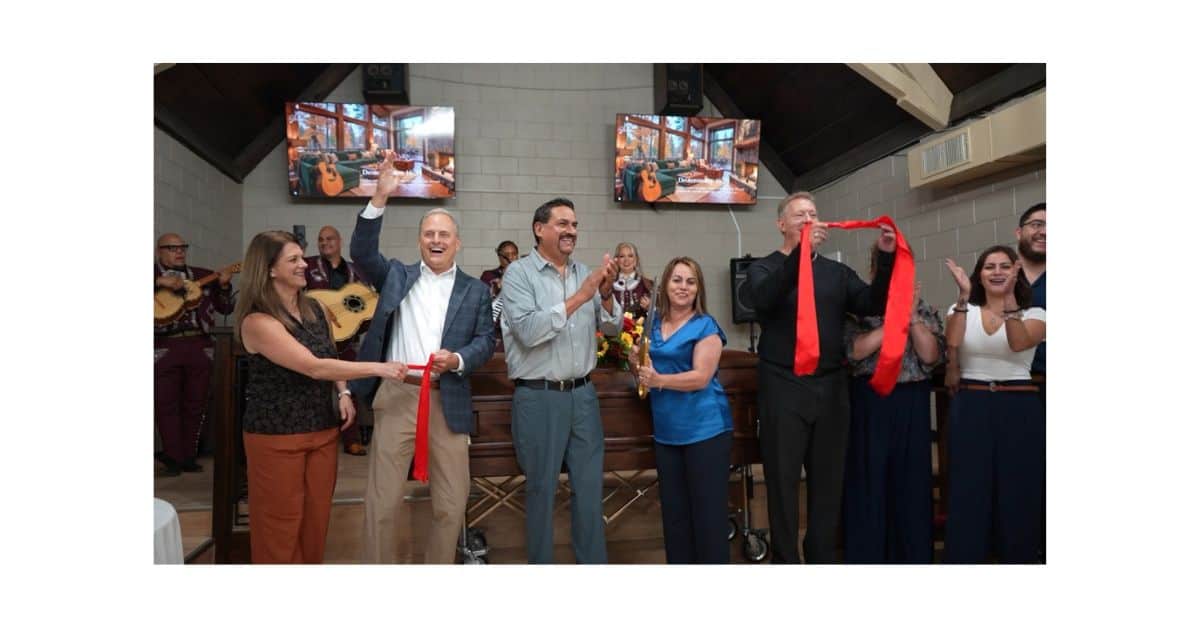
Reutter and de la Torre bootstrapped the entire enterprise. Setting a modest goal to serve 1% of the local Hispanic market in their first year, they marked their official grand opening with a vibrant community gathering complete with taco trucks, mariachi music, and kid-friendly inflatables. In doing so, they established a welcoming space where grief, cultural tradition, faith, and community support could come together.