

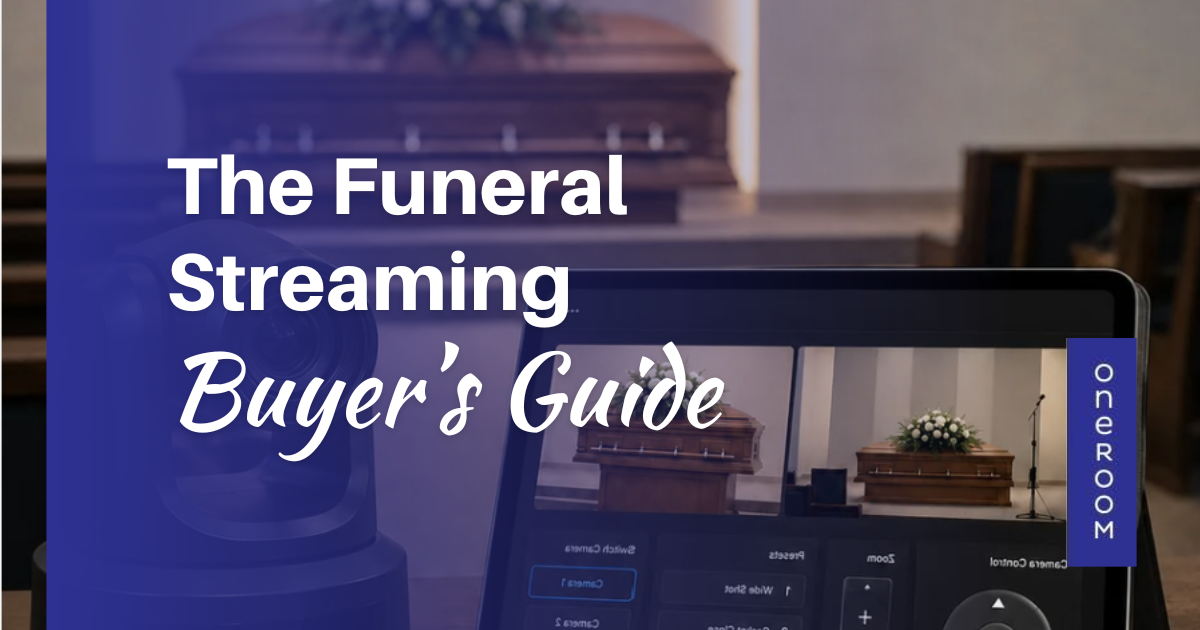
Streaming has become an expected part of the service for many funeral homes, giving people who can’t be there in person a way to attend, and families a recording they can return to afterwards.
But choosing a streaming provider isn’t as straightforward as it might first appear. There are significant differences in the technology, reliability, level of support and what families ultimately receive. Some of those differences only become obvious once you know what to look for.
Whether you’re introducing streaming, reviewing your current setup or looking to change providers, this guide will help you understand what matters most when comparing your options. And the best place to start is reliability.
Short on time? Jump to the 10 questions to ask a funeral streaming provider at the end of this guide.
1. How reliable is the streaming system?
For many funeral directors, reliability is the biggest concern when it comes to streaming, often because of a bad experience in the early days of streaming.
When something goes wrong, families can be understandably upset, and one experience like that can be enough for a funeral director to lose confidence in streaming altogether.
Technology has moved on considerably, but there are still big differences between providers and the safeguards they have in place. So reliability should be the first thing you assess when choosing a streaming provider. It’s the foundation. Before considering additional features, you need confidence the service will be captured and delivered.
Every provider will say their system is reliable, so look at what sits behind that claim. There should be safeguards throughout the process, including checks before the service, monitoring and automatic detection of problems, and backup systems if something goes wrong.
Look specifically for a separate backup recording and backup audio source, and understand what happens if the internet connection is interrupted or you are streaming from a location without internet.
2. What type of streaming setup does your funeral home need?
The right setup will depend on where you hold services, how often you stream and how much you want to invest upfront.
Fixed cameras
For funeral homes streaming regularly from their own chapel, a permanently installed camera system can offer greater reliability and require less staff involvement.
The cameras are always in place, and automated systems can start and stop at scheduled times. There’s no equipment to find, charge, transport or set up before each service.
A fixed system usually requires more investment upfront, but the margin earned on each stream pays for that investment over time. How often you stream will determine how quickly the system pays for itself.
Mobile cameras and devices
Mobile setups offer flexibility and can have a lower upfront cost, making them useful for funeral homes that stream infrequently or need to cover gravesides, churches and other locations.
They require more staff involvement, with equipment needing to be charged, transported, positioned and started at the right time. Cell phones and other devices can also introduce considerations around battery life, storage and overheating.
With good training and an established routine, a mobile system can work very smoothly. For funeral homes that stream infrequently or across different locations, that extra involvement can be well worth it.
Or do you need both?
For many funeral homes, it doesn’t have to be one or the other.
A fixed system can cover regular chapel services, while a mobile camera provides the flexibility to stream gravesides and services at other locations.
What about pan, tilt and zoom?
If you want a straightforward streaming setup, you may not need PTZ. But for a more premium, produced service, it’s worth exploring. Cameras can be controlled by your staff, use presets or automation, or be operated remotely by the provider. Understand how each option works and whether there are additional staff requirements or costs.
3. What support is available when it matters?
Reliability should reduce the chances of something going wrong. But when you’re dealing with a funeral service and something does need attention, there’s nothing more important than knowing you can pick up the phone and speak to a real person with the technical expertise to help.
Look closely at how support actually works. Can you call and speak to someone who understands the technology, or are you dealing with a chatbot, email address or support ticket? And if the problem needs deeper technical expertise, can it quickly reach a technician who can diagnose and resolve it?
Support for families and online guests matters too. Some people watching a funeral may be less confident with technology or using older devices, so problems aren’t always with the platform itself. If someone can’t access the service, has no sound or needs help using the viewer, find out whether the provider supports them directly or whether those calls will come back to your team.
Look at the onboarding and training provided when you get started, as well as how new staff are trained later.
One particularly useful way to assess support is to ask providers what their support teams are contacted about most often by funeral homes and online guests. The answer can tell you a lot about the issues you’re likely to encounter.
4. What kind of experience will your families and online guests have?
Families and online guests will form an impression of your funeral home from their streaming experience. Before choosing a provider, experience a service exactly as they would.
Get the basics right first
The experience should be simple from the moment someone arrives. It should work well on a phone, be easy to navigate and deliver clear audio and good-quality video. The platform should feel current and professional, with your funeral home’s branding taking priority over the streaming provider’s. Ultimately, it should feel like something you’re comfortable putting your funeral home’s name to.
Then look at what else is available
Beyond the basics, platforms offer different ways to improve the experience for families and online guests. These can include captions and translations, different camera views, guest registration and attendee lists, messages and photo sharing, and access to grief support or other resources.
Some will matter more to your families than others. Focus on the features that add genuine value to the experience you want to provide rather than the length of the feature list.
5. What does the family receive after the service?
Don’t evaluate a streaming provider only on the live service. Families will want to return to the recording afterwards, so what they receive matters too.
A downloadable file or memory stick gives the family a permanent copy, but it can be less convenient to watch and won’t include the features of an online platform. Look for the option to retain a permanent copy while keeping the service available online, and understand how long that access lasts and what it costs to extend.
Some providers also create edited recordings or curated content around individual stories, tributes or moments. Consider what will genuinely add value for your families. The recording can be something they return to long after the funeral, so the experience continues to reflect the service your funeral home provided.
6. How does the provider handle copyrighted music in the USA?
For funeral homes in the United States, music copyright is an important consideration when comparing streaming providers, particularly when a service is recorded and made available afterwards.
The licenses commonly used by funeral homes may allow copyrighted music to be played during a service and streamed live, but that doesn’t necessarily give you the right to reproduce that music within a recording that can then be downloaded, stored or shared.
Streaming providers take different approaches to this, so understand how each one handles copyrighted music and match that against what matters to your funeral home.
If keeping the music in the recording is important to you and your families, look for a provider that gives you that option and understand the copyright risk you are accepting. If your priority is to minimise that risk, look for a solution that automatically removes copyrighted music from the recording.
7. Can the platform help generate pre-need opportunities?
For funeral homes focused on growing pre-need, streaming can provide another source of opportunities. Guest registration can give you visibility of who attended online, including guests in your local community.
Pre-need functionality differs considerably between platforms. Some simply provide a button linking to a pre-planning page on your website. Others allow guests to request information or a call back, capturing their interest and details for your team to follow up.
If pre-need growth matters to your business, understand exactly how the process works from guest interest through to the lead reaching your team, and whether it’s included or costs extra.
10 questions to ask a funeral streaming provider
There’s a lot to compare, but not everything needs to carry equal weight. Start with the fundamentals: reliability, the right setup for your funeral home, good technical support and an experience you’re happy to provide to your families.
From there, look at the additional features and capabilities that matter to your funeral home and the way you want to serve families.
Use these 10 questions when comparing providers:
- What safeguards do you have in place to make sure every service is captured?
Look for pre-service checks, monitoring, alerts, backup recording and backup audio.
- What happens if the internet connection is interrupted during a service?
- What streaming setup would you recommend for our locations and service volume, and why?
Consider fixed cameras, mobile equipment or a combination, along with upfront investment and staff involvement.
- When we need help, can we speak to someone with technical expertise, and when is that support available?
- Do you provide support directly to families and online guests?
- What onboarding and ongoing training do you provide for our team?
- Can you show us exactly what our families and online guests will experience?
Experience it yourself on a phone and look at access, usability, audio and video quality, presentation, branding and additional features.
- What does the family receive after the service?
Understand how they can keep the recording, how long it remains available online and whether extended access costs extra.
- How do you handle copyrighted music in funeral recordings?
Make sure the provider’s approach matches what is important to your funeral home and the level of copyright risk you are comfortable with.
- How does your platform help generate pre-need opportunities, and is that functionality included in the cost?
Understand the difference between simply linking to a pre-planning webpage and capturing a guest’s interest and details for follow-up.