

Ashes To Ashes, And Death To Life: Lovelier, Greener Burial Options
There is perhaps no more appropriate time of year to discuss death than right now, on Halloween Eve, and Día de los Muertos Eve Eve. It’s not the most fun subject, but thanks to a few new burial options, it’s a bit more sustainable and even beautiful…
Scientific American says it well: “Modern western-world burial practices are arguably absurd, all things considered: We pack our dearly departed with synthetic preservatives and encase them in impenetrable coffins meant to defy the natural forces of decomposition that have been turning ashes to ashes and dust to dust for eons.” Along with this, shall we call it, denial, there is a tremendous amount of waste in modern burials, at least in America. According to National Geographic,
“American funerals are responsible each year for the felling of 30 million board feet of casket wood (some of which comes from tropical hardwoods), 90,000 tons of steel, 1.6 million tons of concrete for burial vaults, and 800,000 gallons of embalming fluid. Even cremation is an environmental horror story, with the incineration process emitting many a noxious substance, including dioxin, hydrochloric acid, sulfur dioxide, and climate-changing carbon dioxide.”
That’s heartbreaking. Death is hard enough to contemplate, but the last thing I want to do after I’m gone is make the world worse for everyone else still here. Sure, I’ve loved trees and steel and concrete in this life, but I certainly don’t need them once I’ve passed away. You guys enjoy them! And after trying so hard to be a good person, I really don’t want my final contribution to the world to be a noxious substance.
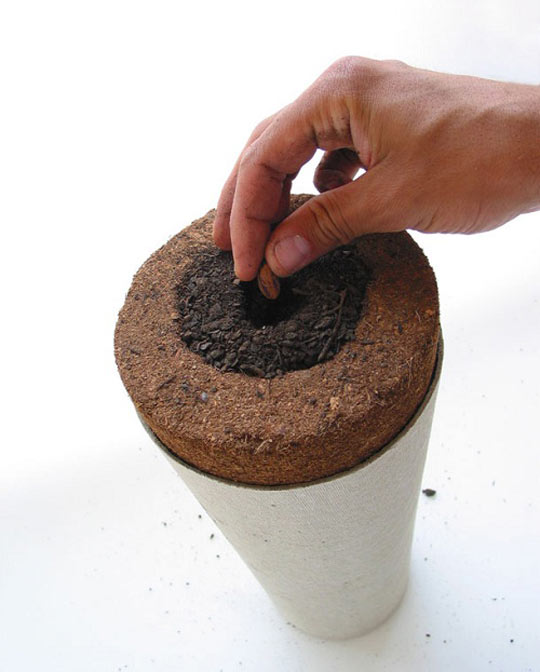
So, what to do? Scientific American lists a few options, including sustainably-harvested more-biodegradable coffins, trees instead of headstones, dry ice instead of embalming fluid, and specially-designed urns that can become part of ocean reefs. The Huffington Post likewise lists horrifying statistics (formaldehyde causes cancer and prevents a corpse from “decomposing efficiently, and this slow rotting process favors sulfur-loving bacteria, which can harm nearby water sources”) and better, more affordable alternatives. Two that caught my eye were a new technology that can turn a corpse into compost, and a bicycle hearse. Design Taxi featured Martín Azúa’s Bios Urn (shown above), a biodegradable urn that holds ashes and the tree seed of your choice (although keep in mind that according to the Huffington Post, “the energy used to cremate one body is equivalent to driving 4,800 miles”).
Would you like a “green burial”? Do you have something particular in mind, and most importantly, have you communicated this to your loved ones?
Article Source: Apartment Therapy
(Image: Martín Azúa via Design Taxi)

Funerals and burials have little if anything to do with science! Fundamentally they are a religious/spiritual expression which by definition is separate from scientific measurement. So why in the world is Scientific American butting their nose into religious practice and trying to tell the world that it is wrong?
We do extravagant things all the time because in our hearts the choice matters and in the end it doesn’t feel like an extravagance at all.
We can say that houses are and extravagance and that we should all live in communal caves because they have less impact on the environment.
That’s the same kind of nonsense that Scientific American is trying to foist on the world with their commentary.
We have culture. We have desires and hopes and dreams and wishes and wants, and we need ways to express our inner lives. For many a “traditional” burial fulfills those needs and there is nothing wrong with those choices, because not everything in life revolves around such a narrow definition of waste.
The editorial staff of the magazine needs to reevaluate their standards of reporting.
Traditional burials is vanity in a box.
JOBS? Think about the people employed to cut trees, bend metal for caskets, producing paper products, mixing HCHO etc. In an economy that is already a disaster should we just give all these people a pink slip as well? I think the industry/suppliers are the ones pushing green burial etc.
Agree with the point that it is all about what the family or departed wants, and it will always be that way. As funeral professionals, we need to be mindful of not projecting our own wishes or the desire to get as much profit as we can from each funeral. Green burial tends to be a lifestyle choice…have heard of a few requests here & there, but don’t think it’s going away. Important to remember that a satisfied family will be returning customers in future, regardless of THEIR choices.